
How AI Coaching Helps Managers Give Better Feedback
August 7, 2026
9 minutes
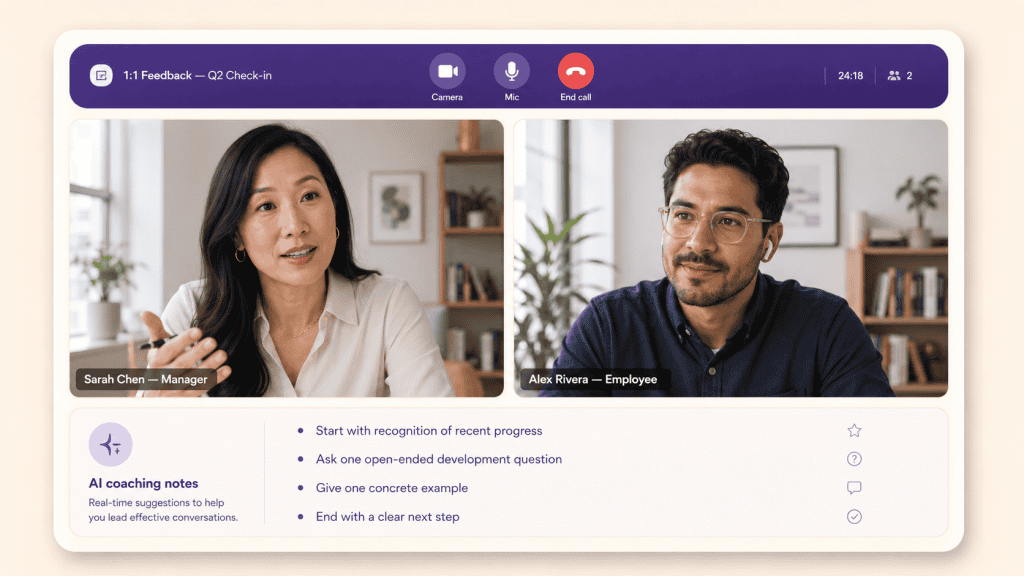

Most managers don’t actually lack feedback to give. They lack the confidence and the context to give it. According to LeadershipIQ’s 2025 manager effectiveness study, 67% of managers avoid giving feedback, and only 35% say they can handle difficult conversations well. SHRM research paints the same picture from the HR side: 61% of HR professionals report that fewer than half of their managers effectively address underperformance or areas for improvement among direct reports.
The result shows up directly in how employees experience feedback. Gallup finds that only 21% of employees strongly agree they received meaningful feedback from their manager in the previous week, and 47% say they received manager feedback only a few times or less during the entire previous year — despite employees who get weekly meaningful feedback being 3.5 times more likely to be engaged.
This isn’t a training problem that another workshop will fix. It’s a practice and preparation problem — and it’s exactly the gap AI coaching is now closing.
TL;DR
- 67% of managers avoid giving feedback — the barrier isn’t willingness, it’s confidence and preparation.
- 61% of HR professionals say fewer than half their managers effectively address underperformance, largely due to insufficient training.
- AI coaching closes the gap through three mechanisms: rehearsal, automatic context-prep, and in-the-moment prompts — not by replacing the manager.
- Employees with weekly meaningful feedback are 3.5x more engaged, yet only 21% report actually receiving it.
- 57% of organizations already using AI in performance management use it specifically to help managers give more comprehensive, actionable feedback.
Why Feedback Breaks Down Before It Ever Starts
Two structural issues explain most of the feedback gap, according to SHRM research: 43% of HR professionals report that managers are insufficiently prepared to conduct effective reviews, and 60% say managers aren’t given the data-driven insights they’d need to make feedback specific and credible. Combine an undertrained manager with no supporting context, and the default behavior is avoidance — soften the message into vague generalities, delay the conversation, or skip it entirely.
This mirrors what we’ve seen across the broader manager population — a lack of practice, not a lack of intent, is consistently the real constraint. For the full research on why this shows up specifically at the manager layer, see our analysis of why manager engagement just hit a 5-year low.
The annual or quarterly review format compounds the problem. Feedback delivered months after the moment it was earned has already lost its specificity and its stakes — by the time the meeting happens, neither the manager nor the employee remembers the details well enough to make the conversation useful.
What AI Coaching Actually Changes About Giving Feedback
AI coaching doesn’t hand managers a script to read. It attacks the feedback gap from three distinct angles — each addressing a different reason managers avoid or fumble the conversation.
| What managers lack | How AI coaching helps |
|---|---|
| Confidence for difficult conversations | Managers rehearse the actual conversation — including pushback and defensiveness — before having it for real, so the first attempt isn’t live. |
| Context going into the conversation | Recent work, prior commitments, and relevant data are assembled automatically, so managers walk in prepared without doing the prep themselves. |
| Timely prompts to act | Feedback is surfaced at the moment it’s relevant — right after a collaboration or a missed deadline — instead of waiting for a scheduled review weeks later. |
Among organizations already using AI in performance management, 57% use it specifically to help managers give more comprehensive and actionable feedback to their teams — not to automate the review itself, but to make the manager’s own delivery sharper.
Rehearsal Before the Real Conversation
The single biggest shift AI coaching introduces is the ability to practice a specific, high-stakes conversation before it happens for real. A manager preparing to address a missed deadline, a tone issue, or a pattern of underperformance can rehearse the exact conversation with an AI counterpart that pushes back, deflects, or gets defensive — the same dynamics that make the live version stressful — and get structured feedback on their approach before anyone’s actual performance review is on the line.
This is the same mechanism explored in depth in our guide on how to give feedback that actually changes behavior, and in the research behind AI avatar roleplays more broadly: rehearsal under realistic resistance is what separates knowing what good feedback looks like from being able to deliver it under pressure.
Automatic Context, Not Automated Judgment
A recurring failure mode SHRM identifies is managers arriving at a feedback conversation without the data to make it specific — which is precisely what turns feedback into vague, forgettable generalities like “communicate more clearly.” AI coaching tools solve this by assembling the relevant context automatically: what the employee actually worked on, what was committed to in the last conversation, and what changed since then.
Importantly, this is preparation, not replacement. As SHRM’s research puts it plainly: AI can supply the “what,” but managers still have to deliver the “why” and “how” with human judgment and empathy. The tool removes the prep burden — it doesn’t remove the manager from the conversation.
Feedback in the Flow of Work, Not Once a Year
The final shift is timing. Feedback that arrives during a scheduled annual or quarterly review has already lost the specificity that makes it useful — the moment has passed, the details are fuzzy, and the stakes feel disconnected from daily work. AI coaching tools instead prompt feedback close to the moment it was earned: right after a project wraps, a difficult client call ends, or a deadline is missed.
This continuous approach maps directly onto what Gallup identifies as one of the strongest engagement drivers available to managers — frequent, specific dialogue, rather than an annual event. It’s also the same underlying architecture behind scaling manager development across an entire organization rather than a handful of senior leaders; see our breakdown of scaling manager development with AI + human coaching for the full model.
Train Your Managers on Difficult Conversations with AI
Building a coaching culture isn’t enough. Your managers need to practice high-stakes conversations in a safe, realistic, and measurable environment.
With our personalized AI Roleplays, your teams rehearse real-world scenarios, receive an intelligent debrief, and measurably improve the quality of their leadership conversations.
Try our AI Avatar Roleplay Coach →
Why AI Alone Isn’t the Whole Answer
AI coaching improves feedback delivery — it doesn’t replace the manager’s judgment, and treating it as a full substitute introduces its own risks. SHRM’s research flags two specific concerns worth taking seriously: AI performance tools can raise privacy and surveillance concerns that erode trust in an already-fraught process, and systems trained on biased or flawed data can scale inequities rather than resolve them.
The safeguard isn’t avoiding AI — it’s governance. Cisco’s CHRO Kelly Jones frames the right posture well: AI in coaching isn’t about replacing the conversation, it’s about deepening it. That distinction matters operationally too. This is the same principle we cover in more depth in our guide to the dangers of corporate coaching — specifically the risks around AI data handling and the limits of artificial empathy compared to human judgment.
Getting the Rollout Right
| Step | What it involves |
|---|---|
| 1. Pilot with a small group | Test with a volunteer group first, and be transparent about the pilot’s purpose, how data is used, and the tool’s limitations. |
| 2. Train managers on interpretation | Managers should learn how to blend AI-generated insights into authentic conversations — not simply relay what an algorithm says. |
| 3. Monitor for bias continuously | Audit outcomes regularly to ensure the technology isn’t penalizing certain groups or creating a culture of surveillance. |
| 4. Keep managers accountable | Use AI to supplement manager ownership of their team’s development — not to shift that ownership onto the tool. |
For a structured way to turn any feedback or coaching insight into a measurable behavioral commitment — rather than just a good conversation that fades within weeks — see our assessment debrief guide.
What This Looks Like for a Manager, Day to Day
In practice, the shift is less dramatic than it sounds. A manager preparing for a 1:1 opens a prepared agenda built from recent work activity, open commitments from the last conversation, and any flagged concerns — instead of starting from a blank page. Before a harder conversation, like addressing a pattern of missed deadlines, they run through the conversation once with an AI counterpart that pushes back the way the real employee might, get feedback on where their delivery landed too soft or too blunt, and adjust before the real thing.
None of this replaces the manager’s relationship with their team. It removes the two things that most reliably cause managers to avoid feedback altogether: not knowing exactly what to say, and not having said it out loud before the moment it actually matters.
Frequently Asked Questions: AI Coaching for Manager Feedback
Why do most managers struggle to give good feedback?
Most managers don’t lack feedback to give — they lack the confidence and context to give it well. 67% of managers avoid giving feedback, and only 35% say they can handle difficult conversations well (LeadershipIQ, 2025). 61% of HR professionals report fewer than half of their managers effectively address underperformance, largely because 43% say managers are insufficiently trained to conduct effective reviews (SHRM).
How does AI coaching improve manager feedback?
AI coaching improves feedback in three ways: it lets managers rehearse a difficult conversation before having it for real, it automatically prepares conversation context, and it prompts feedback at the moment it’s most relevant instead of weeks later. 57% of organizations using AI in performance management use it specifically to help managers give more comprehensive, actionable feedback.
Does AI feedback replace manager judgment?
No. AI can provide the structured prompts and behavioral data — the “what” — but managers must still deliver the “why” and “how” with human-centered context. The strongest implementations use AI to prepare and rehearse the conversation, not to replace the manager’s judgment.
How often should managers give feedback?
Frequently, not just at review time. Employees who receive weekly meaningful feedback are 3.5 times more likely to be engaged (Gallup), yet only 21% of employees strongly agree they received meaningful feedback from their manager in the previous week, and 47% say they received it only a few times or less in the entire previous year.
What should HR do before rolling out AI coaching for feedback?
Pilot the tool with a small volunteer group first, train managers on how to interpret and use AI-generated insights rather than simply relaying them, continuously monitor for bias, and use AI to supplement — not replace — manager accountability for their team’s development.
Ready to Help Your Managers Give Feedback That Actually Lands?
Discover how Coachello combines AI-powered rehearsal with certified human coaches to give every manager — not just your top performers — the confidence and practice to deliver feedback that changes behavior.
Share this article



Unlock the Power of Coaching
Enhance leadership, boost performance, and drive growth with AI-powered and human-led coaching. Read articles from coaches, psychologists, and business leaders to help you boost performance, improve well-being, and lead with confidence.

Enter your email and we’ll send you the brochure