
Manager Engagement Is at a 5-Year Low: What’s Actually Driving the Collapse
July 21, 2026
9 minutes


Manager engagement has dropped from 31% in 2022 to 22% in 2025, and for the first time since Gallup began tracking the metric, managers no longer report higher engagement than the people they lead (Gallup, 2026). Global employee engagement overall has fallen to a five-year low of 20%, and Gallup estimates disengagement cost the world economy more than $10 trillion in lost productivity last year alone.
So what happens when the people whose job is to re-engage everyone else are the most disengaged group in the building? And why is this collapse concentrated so heavily at the manager layer, rather than spread evenly across the workforce?
The honest answer is that manager engagement isn’t collapsing on its own — it’s the predictable output of two structural failures most HR teams haven’t fixed: managers are being asked to carry more than the role was ever designed to hold, and most of them were never actually trained to do the job in the first place. This article breaks down what the data says is driving the collapse, and the coaching model that best-practice organizations are using to reverse it.
- Manager engagement fell from 31% to 22% in three years — a steeper drop than any other job category Gallup tracks.
- Two structural causes: span of control grew ~50% since 2013, and 85% of new managers receive no formal training.
- A disengaged manager doesn't just lower one score — they break the Engagement-to-Retention Pipeline for every direct report who depends on them.
- Employees who get coaching alongside training show an 86% productivity gain, vs just 22% from training alone.
- Best-practice organizations average 70% engagement — more than 3x the global rate — proving this is a design failure, not an inevitability.
Which AI coaching solution fits your team?
Why Manager Engagement Is Falling Faster Than Everyone Else’s
For most of the last decade, managers reliably out-engaged their teams — it was one of the more stable patterns in workplace research. That pattern has now inverted. Manager engagement fell from 31% to 22% between 2022 and 2025, a steeper drop than any other job category Gallup tracks, while employee engagement declined more slowly over the same period (Gallup, 2026).
This matters more than a single HR metric sliding downward, because of what Coachello calls the Engagement-to-Retention Pipeline: employees move from Learning a skill, to Applying it on the job, to Advancing in their role, to Advocating for the organization — and the manager is the connective tissue at every single stage of that pipeline for every person on their team. A disengaged manager doesn’t just represent one unhappy data point. They represent a broken link for every direct report who depends on them for feedback, recognition, and development. When the manager checks out, the whole pipeline stalls underneath them, not just their own engagement score.
That’s the real reason this specific collapse should worry HR leaders more than a dip in general employee sentiment: it doesn’t stay contained to one person.
The Middle Manager Squeeze: Why the Job Itself Got Harder
Managers aren’t disengaging because they suddenly stopped caring. They’re disengaging because the job has structurally expanded while the support around it hasn’t.
The average manager’s span of control has grown roughly 50% since 2013, climbing from 10.9 direct reports in 2024 to 12.1 in 2025, as companies flattened org charts to cut costs (Organimi, 2026). Managers now spend less than half their time actually managing people — the rest is absorbed by administrative load, upward reporting, and firefighting problems before they reach leadership.
Roughly 45% of middle managers report burnout, a higher rate than any other employee group tracked, and managers are now 36% more likely to report burnout than their own direct reports (Success, 2026). One survey of nearly 1,000 middle managers found 75% report extreme burnout, with more than one in four actively planning to leave their role.
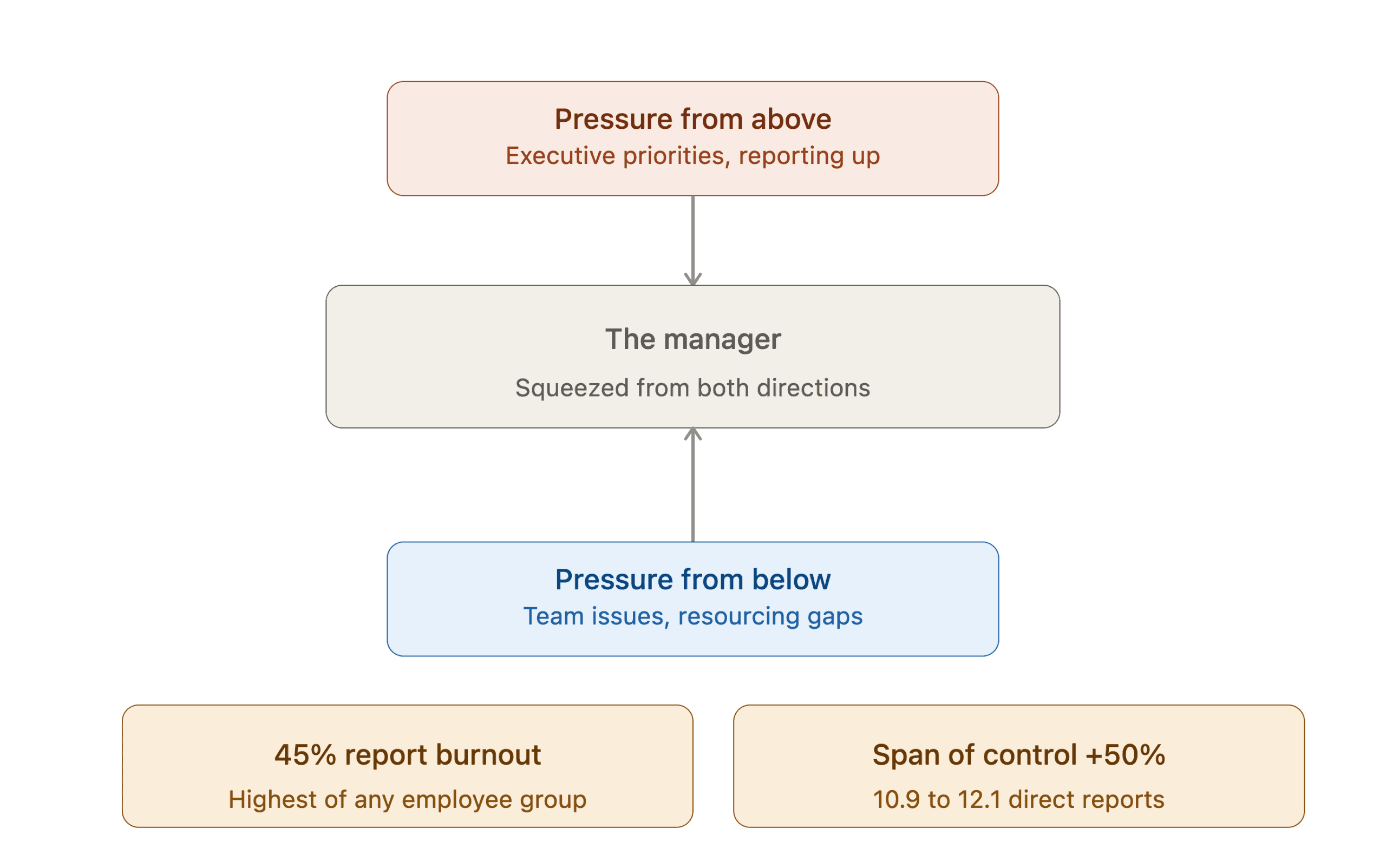
This is what’s been called the middle manager squeeze — pressure from above (translating executive priorities into daily execution) and pressure from below (absorbing every complaint and resourcing gap before it escalates) hitting the same person, at the same time, with fewer resources than a decade ago. No amount of individual resilience training fixes a structural problem like this. It requires the organization to change what it’s asking the role to absorb.
The Training Gap Nobody Fixed: Promoted, Then Left Alone
Most managers were never actually taught how to manage. They were promoted for being good at their previous job, not because anyone assessed or built their leadership capability.
85% of new people managers receive no formal training when they step into the role, according to Gartner research (Fast Company, 2026). Separate research from the Center for Creative Leadership found 60% of new managers never received any training during their transition into a first leadership role. The consequence is measurable: roughly 60% of new managers fail within their first two years, largely attributable to that missing preparation.
This is precisely where the Engagement-to-Retention Pipeline breaks at its first stage. A manager who was never taught how to run a feedback conversation, delegate under pressure, or de-escalate conflict isn’t stuck because they lack motivation — they’re stuck because they were pushed straight from “Learning” to “Applying” with no practice in between, in front of an audience of direct reports who are watching them figure it out in real time. That’s an exhausting, engagement-draining position to sit in every day, and it compounds every time the manager avoids a hard conversation because they were never given a safe place to rehearse it first.
What Actually Fixes It: Coaching the People Who Are Supposed to Coach Everyone Else
The core irony of the manager engagement collapse is that managers are the people HR expects to deliver feedback, recognition, and development to everyone else — while receiving almost none of that themselves. Most L&D budgets are still weighted toward individual contributor training or one-off leadership workshops for senior executives, leaving the layer in between chronically under-resourced.
The evidence that this is solvable, not inevitable, is strong: best-practice organizations average 70% engagement — more than three times the global rate — proving the collapse is a design failure, not an unavoidable feature of modern work (Gallup, 2026). Employees who receive coaching alongside training show an 86% productivity gain, compared to just 22% from training alone, and that gap is even more pronounced for managers, whose job is fundamentally a set of conversations — feedback, delegation, conflict, recognition — that most of them were never coached through in the first place.
This is also where scale becomes the practical obstacle. Executive 1:1 coaching works, but no organization can afford to put 12,000 frontline managers through individualized human coaching. This is where AI-supported practice closes the gap: a manager can rehearse a specific, high-stakes conversation the night before it happens, get immediate feedback, and repeat it until it’s second nature — the exact practice loop that formal manager training almost never includes. For a full breakdown of how each coaching model scales differently across an organization, see our guide to the best business coaching programs for your organization.
Platforms such as Coachello build programs specifically around this layer of the organization, combining tripartite coaching sessions — coach, manager, and their own manager — with AI avatar roleplays so frontline and first-time managers get the practice rep that a one-time promotion announcement never provides.
How HR Leaders Can Actually Reverse the Collapse
Fixing manager engagement isn’t a matter of adding another wellness webinar to the calendar. It requires treating the manager layer as its own distinct population with its own coaching needs — not an afterthought squeezed between individual contributor training and executive development.
| Practice | What it looks like |
|---|---|
| Measure manager engagement separately | Track it as its own metric, not folded into a single company-wide number that hides where the damage is concentrated. |
| Give structured practice before live conversations | Real rehearsal of feedback and delegation conversations, before asking managers to have those conversations with their teams. |
| Involve the manager’s own manager | Bring them into the coaching loop, so development doesn’t happen in isolation from the person setting day-to-day priorities. |
None of this is complicated, but almost none of it is currently standard practice — which is exactly why the gap between best-practice organizations (70% engagement) and the global average (20%) is as wide as it is.
Closing the Manager Engagement Gap Starts With the Middle, Not the Top
Manager engagement didn’t collapse because managers stopped caring about their teams. It collapsed because span of control expanded, training was never built, and the people absorbing the most pressure in the organization were given the least support to handle it. Reversing that means closing the same gap the Engagement-to-Retention Pipeline describes at every other level: giving managers the practice and feedback loop to move from knowing what good leadership looks like to actually being able to do it under pressure.
If your organization is trying to figure out where manager engagement is breaking down and what a coaching program built specifically for that layer would look like, book a free consulting call to map it against your current data.
Frequently Asked Questions: Manager Engagement Collapse
Why is manager engagement dropping faster than employee engagement?
Manager engagement fell from 31% in 2022 to 22% in 2025 — a steeper drop than any other job category Gallup tracks, and for the first time managers no longer out-engage the people they lead. This is driven by two structural failures: span of control has grown roughly 50% since 2013, and 85% of new people managers receive no formal training when they step into the role.
What is the middle manager squeeze?
The middle manager squeeze describes pressure from above (translating executive priorities into daily execution) and pressure from below (absorbing every complaint and resourcing gap) hitting the same person simultaneously, with fewer resources than a decade ago. Roughly 45% of middle managers report burnout — a higher rate than any other employee group — and managers are 36% more likely to report burnout than their own direct reports.
How many new managers receive formal training?
According to Gartner research, 85% of new people managers receive no formal training when they step into the role. Separate research from the Center for Creative Leadership found 60% of new managers never received any training during their transition into a first leadership role. Roughly 60% of new managers fail within their first two years, largely attributable to that missing preparation.
What is the Engagement-to-Retention Pipeline?
The Engagement-to-Retention Pipeline describes how employees move from Learning a skill, to Applying it on the job, to Advancing in their role, to Advocating for the organization. The manager is the connective tissue at every stage of that pipeline for every direct report. When a manager disengages, the whole pipeline stalls for everyone who depends on them — not just their own engagement score.
How can HR leaders reverse the manager engagement collapse?
Three practices separate organizations reversing this trend: measuring manager engagement as a distinct metric, giving first-time and frontline managers structured practice for feedback and delegation conversations before they happen live, and involving the manager’s own manager in the coaching loop. Best-practice organizations average 70% engagement — more than three times the global rate of 20%.
Share this article



Unlock the Power of Coaching
Enhance leadership, boost performance, and drive growth with AI-powered and human-led coaching. Read articles from coaches, psychologists, and business leaders to help you boost performance, improve well-being, and lead with confidence.

Enter your email and we’ll send you the brochure