
How to Scale Employee Development with AI Coaching
August 7, 2026
9 minutes


Traditional 1:1 executive coaching runs $300 to $500 per hour — a cost structure that has always meant coaching reaches a small, curated slice of senior leaders and nobody else. Meanwhile, the World Economic Forum projects that 39% of core workforce skills will change by 2030, and 59% of workers will need reskilling to keep up. The gap between who gets developed and who needs to be developed has never been wider — or more expensive to ignore.
Most organizations already know this. 91% of L&D professionals say continuous learning is essential for career success. But only 36% of organizations qualify as career development champions with programs that actually reach their workforce at scale. That gap between intent and execution is where AI coaching is now closing the distance — not by replacing human development, but by making it available to people who were never going to get a $400-an-hour coach in the first place.
TL;DR
- Traditional coaching costs $300–$500/hour, which structurally limits it to a small population of senior leaders.
- 39% of core skills are projected to change by 2030, and 59% of workers will need reskilling — the urgency is now, not later.
- Only 36% of organizations qualify as career development champions, despite 91% of L&D leaders calling continuous learning essential.
- In-the-flow-of-work learning grew 60% between 2020 and 2024, and coaching is now the fastest-growing L&D investment category.
- Organizations leading on development are 88% more likely to pair AI-driven learning with human coaching — not replace it entirely.
Why Employee Development Has Never Scaled Past the Top of the Org Chart
The economics of traditional coaching were never built for scale. At $300–$500 per hour for a certified executive coach, even a modest coaching budget only stretches to cover a handful of VPs and above. Everyone else — the middle managers, the individual contributors, the frontline population that makes up the vast majority of any workforce — gets a once-a-year training day and is expected to develop the rest of the way on their own.
Moving beyond a small executive cohort requires a model that can support many managers consistently. Our comparison of AI coaching companies that scale leadership development shows how different providers approach that challenge.
This isn’t a new observation, but it’s becoming a more expensive blind spot. Average L&D spend already runs $1,200 to $1,500 per employee at mid-to-large companies, and high-performing organizations invest 1.5 to 2 times more than that per employee than their peers. The money is increasingly there. What’s missing is a delivery model that can actually reach everyone the budget is meant to serve — a gap explored in more depth in our research on why most leadership training is wasted without ongoing practice.
The Skills Gap Making Scale Non-Negotiable
The case for scaling development isn’t just about fairness or engagement — it’s about workforce readiness on a tight clock. The World Economic Forum projects that 39% of core skills will change by 2030, and 59% of workers globally will need meaningful reskilling to stay relevant in their roles. Organizations expect roughly 19 out of every 100 workers to be internally redeployed as roles shift — but that redeployment only works if people have been developing transferable skills continuously, not scrambling to catch up after the fact.
63% of employers already cite skills gaps as their single biggest barrier to transformation. A coaching model that reaches 5% of the workforce cannot close a gap of this size, regardless of how good that 5%’s coaching is.
How AI Coaching Actually Solves the Reach Problem
AI coaching doesn’t compete with human coaching on depth — it competes on reach. The fundamental shift is economic: where a certified human coach can serve a handful of people per week, an AI coaching platform can serve an entire workforce simultaneously, at a small fraction of the per-person cost.
| Factor | Traditional 1:1 coaching | AI coaching |
|---|---|---|
| Cost | $300–$500 per hour | A small fraction of that cost per employee, per month |
| Reach | A curated population — typically senior leaders only | The entire workforce simultaneously |
| Availability | Scheduled sessions, limited by coach capacity | On demand, available whenever development is needed |
| Consistency | Varies by individual coach | Standardized against the same competency framework for everyone |
This is the same structural shift covered in our guide to scaling manager development with AI + human coaching — AI doesn’t need to be as deep as a senior executive coach to be transformative for someone who currently receives no development at all. For most of the workforce, the realistic comparison isn’t “AI coaching vs. a great human coach.” It’s “AI coaching vs. nothing.”
Give Every Employee Access to Development — Not Just the Top 5%
Traditional coaching budgets stretch to cover a handful of senior leaders. Your entire workforce needs a place to practice and grow.
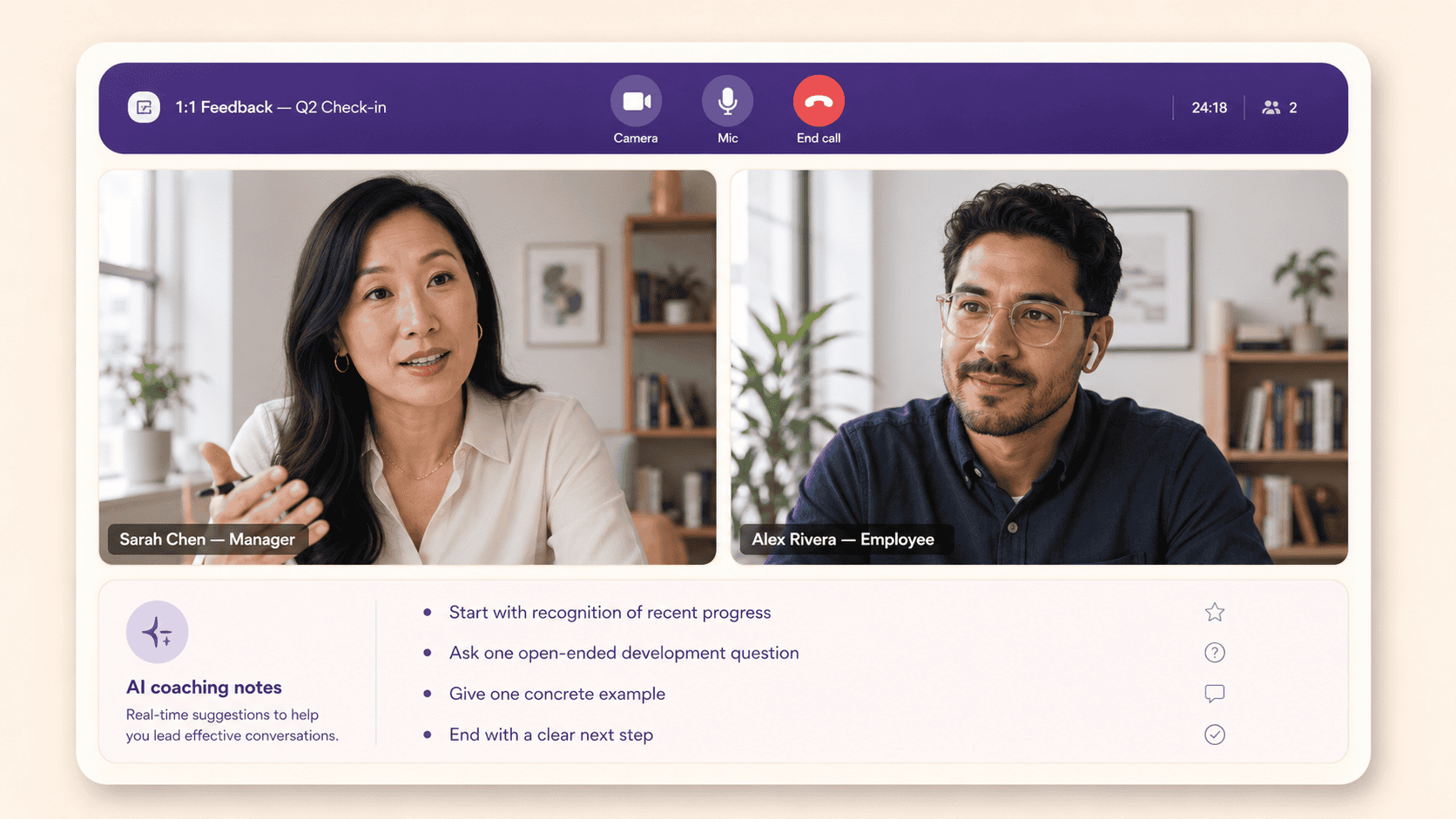
With AI Avatar Roleplays, every employee rehearses real-world scenarios on demand, receives an intelligent debrief, and builds skills continuously — not just once a year.
Try our AI Avatar Roleplay Coach →
What Scaled Development Actually Looks Like in Practice
Scaling isn’t just about adding more seats to an LMS license. The organizations getting this right have shifted where development happens, not just how many people it reaches. In-the-flow-of-work learning grew 60% between 2020 and 2024, and coaching is now the fastest-growing L&D investment category — a clear signal that the winning model embeds development into daily work rather than isolating it in scheduled training events.
In practice, this means an employee preparing for a difficult client conversation practices it that morning, not at the next quarterly workshop. It means a new manager rehearses a delegation conversation the night before having it, not months after struggling silently. This continuous model is the same principle behind why AI coaching helps managers give better feedback — proximity to the actual moment of need is what makes practice stick.
Why AI Alone Doesn’t Close the Gap — Pairing Matters
Scale without depth is its own failure mode. The data on this is clear: organizations leading on career development are 88% more likely to pair AI-driven learning paths with human coaching and project-based practice, rather than deploying AI as a standalone substitute. AI tailors learning paths, tracks completion, and surfaces where someone is struggling — but the highest-stakes, most nuanced situations still benefit from human judgment.
There’s also a governance dimension worth taking seriously at scale: 64% of employees say their company provides AI tools, but only 25% strongly agree their employer has a clear vision for how to actually use them. Rolling out AI coaching without a clear framework for what it’s for — and what it isn’t for — is how adoption stalls before it ever reaches critical mass. For a fuller look at the governance and risk questions worth answering before scaling any coaching program, see our guide to the dangers of corporate coaching.
| Practice | What it looks like |
|---|---|
| Pair AI with human coaching | AI handles continuous practice and reach; human coaches handle depth, complexity, and judgment calls. |
| Anchor learning to a skills map | Development is built against an actual inventory of current and future skill needs — not a generic course catalog. |
| Embed development in daily work | Practice happens where and when it’s needed, not concentrated in scheduled annual events. |
| Give development a destination | Skills connect to visible role progression — learning without a clear path forward gets abandoned. |
A Practical Framework for Scaling Development in Your Organization
Start from a skills inventory, not a course catalog — map what your workforce has today against what roles will require as skills shift, and build development against that gap specifically. From there, use AI to extend that development to everyone, while reserving human coaching for the senior population and highest-stakes situations where depth matters most. This layered approach is covered in full in our guide to corporate coaching solutions for leadership development, which breaks down how to combine 1:1, group, and AI-driven models by organization size and budget.
Finally, give people somewhere to go with what they develop. Internal mobility only works if reskilled employees can actually move into new roles — publish the skills each step on the career ladder requires, so development connects to a visible outcome rather than existing in isolation.
Frequently Asked Questions: Scaling Employee Development with AI Coaching
Why doesn’t traditional employee development scale?
Traditional 1:1 coaching typically costs $300–$500 per hour, which limits it to a small population of senior leaders. Only 36% of organizations qualify as career development champions with robust, scaled programs, even though 91% of L&D professionals say continuous learning is essential for career success — a gap between intent and execution, not a lack of investment.
How does AI coaching make employee development scalable?
AI coaching removes the cost and scheduling constraints that limit traditional coaching to senior leaders. Where 1:1 human coaching runs $300–$500 per hour, AI coaching can be deployed to an entire workforce at a small fraction of that cost per person, making continuous, personalized development available to every employee rather than a curated few.
Why is scaling employee development urgent right now?
The World Economic Forum projects that 39% of core workforce skills will change by 2030, and 59% of workers will need reskilling. Organizations that only develop a small slice of senior talent are leaving the vast majority of their workforce unprepared for that shift, at exactly the moment skills are changing fastest.
Should AI coaching replace human coaching entirely?
No. Organizations that lead on career development are 88% more likely to pair AI-driven learning paths with human coaching and project-based practice, rather than using AI as a standalone replacement. AI handles the scale and continuous availability; human coaches handle judgment, complex situations, and relational depth.
What does scaled employee development look like in practice?
It looks like development embedded in the flow of daily work rather than concentrated in scheduled events — in-the-flow-of-work learning grew 60% between 2020 and 2024, and coaching is now the fastest-growing L&D investment category. In practice, employees access coaching and practice on demand, inside the tools they already use.
Ready to Make Development Available to Your Entire Workforce?
Discover how Coachello combines AI-powered practice with certified human coaches to give every employee — not just your senior leaders — continuous access to development that fits their actual skill gaps.
Share this article


Unlock the Power of Coaching
Enhance leadership, boost performance, and drive growth with AI-powered and human-led coaching. Read articles from coaches, psychologists, and business leaders to help you boost performance, improve well-being, and lead with confidence.

Enter your email and we’ll send you the brochure