
AI Coaching for Hybrid and Remote Teams: Use Cases and Benefits
August 7, 2026
9 minutes


Roughly 50–55% of knowledge workers globally now operate in hybrid roles, making hybrid the dominant working model rather than a temporary exception. And hybrid workers aren’t just adapting to this shift — they’re leading it on AI adoption. 89% of hybrid workers use or have experimented with AI at work, compared to 80% of in-office workers and just 61% of fully remote employees.
That combination — a workforce that’s mostly distributed, and already comfortable with AI tools — is exactly why AI coaching has found one of its strongest use cases in hybrid and remote teams. But adoption alone doesn’t solve the structural gaps distributed work creates. Only 28% of companies have created clear team agreements for how hybrid work should actually function, and teams without a formal collaboration plan are measurably more likely to burn out.
For distributed organizations comparing providers, our guide to AI coaching companies for hybrid and remote teams offers a broader view of the coaching and practice options available to their leaders.
TL;DR
- 89% of hybrid workers already use or experiment with AI at work — the highest AI fluency of any work arrangement.
- Only 28% of companies have clear team agreements for hybrid work, leaving most distributed teams without shared norms.
- Teams with a formal hybrid collaboration plan are 29% less likely to be burned out (Gallup).
- AI coaching removes the time zone constraint that limits human coach availability for globally distributed teams.
- Remote managers lose the informal, in-person cues that used to signal when a coaching conversation was needed — structured AI coaching fills that gap.
Why Hybrid and Remote Teams Are a Natural Fit for AI Coaching
Adoption resistance is usually the biggest obstacle to any new coaching technology — but it isn’t the obstacle here. Hybrid workers already lead every other group on AI fluency: 89% use or have experimented with AI tools at work, well ahead of in-office (80%) and fully remote (61%) employees. Pew Research separately found that 21% of U.S. workers now use AI at least some of the time in their role, up from 16% just a year earlier.
This matters practically. Rolling out AI coaching to a hybrid population doesn’t require the same change-management lift as introducing it to a workforce with no existing AI habits — the comfort level is already there. What’s missing isn’t willingness. It’s structure.
The Structural Gap Distributed Teams Actually Face
Hybrid work removed the office as a default coordination mechanism, and most organizations haven’t replaced it with anything deliberate. Only 28% of companies have created clear “rules of engagement” for how hybrid teams should collaborate, according to Microsoft research. And when hybrid policy exists, it’s rarely built with the team’s input: only 11% of employees are part of teams that set their own hybrid schedule together — the approach Gallup identifies as producing the fairest and most collaborative outcomes, with 91% of employees calling team-set policies fair, compared to just 73% when leadership dictates them top-down.
The cost of leaving this unstructured is measurable. Gallup research finds that teams with a formal hybrid collaboration plan are 29% less likely to be burned out than teams operating without one. And the stakes for getting this wrong are rising: 85% of job seekers now cite remote or hybrid flexibility as a primary factor in their job search, ahead of competitive salary, and 76% say they’d start job hunting if remote work were eliminated through a return-to-office mandate.
This is the same underlying pattern explored in our research on why manager engagement is collapsing — a role that expanded in complexity without the structure or support to match it. Distributed management is a version of the same problem: more coordination required, with fewer of the informal signals that used to make coordination easier.
What Hybrid and Remote Managers Lose Without In-Person Cues
In a co-located team, a manager picks up on a lot without trying — a flat tone in a hallway conversation, a team member who’s gone quiet in meetings, body language that signals something’s wrong before anyone says it out loud. Distributed teams lose almost all of that. A video call captures a fraction of the signal an in-person conversation does, and asynchronous communication captures even less.
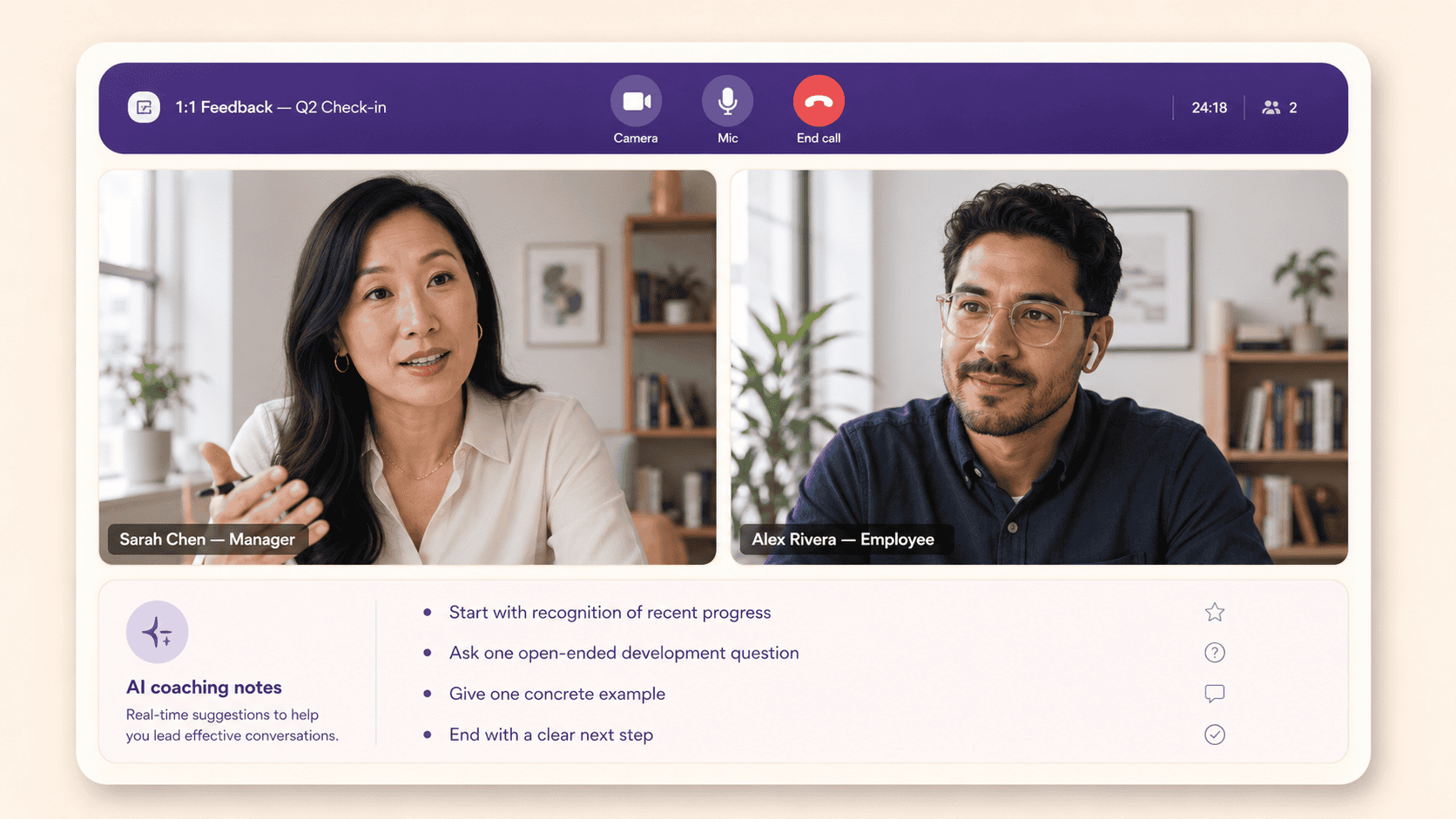
The practical result is that hybrid and remote managers need to be more deliberate about the conversations that used to happen naturally — structured check-ins, explicit boundary-setting, and feedback that doesn’t rely on picking up on subtle cues. This is precisely where rehearsal-based AI coaching adds the most value: a manager can practice a check-in conversation about a team member who seems disengaged before having it for real, compensating for the missing context that in-person management used to provide for free. For the research behind why this rehearsal step matters so much, see our guide to how AI coaching helps managers give better feedback.
Give Distributed Managers a Place to Prepare — Not Just React
Video calls capture a fraction of the signal an in-person conversation does. Your managers need to be more deliberate, not less prepared.
With AI Avatar Roleplays, distributed managers rehearse check-ins and difficult conversations on their own schedule, in any time zone, before the real call happens.
Try our AI Avatar Roleplay Coach →
Four Use Cases Where AI Coaching Fits Distributed Teams Best
| Use case | Why it fits distributed teams specifically |
|---|---|
| Rehearsing difficult conversations | Video calls lose the in-person cues managers rely on — rehearsal compensates for the missing context before the real conversation happens. |
| Onboarding remote-first managers | New managers who’ve never met their team in person can’t rely on shared physical presence to build trust — structured practice helps them build rapport deliberately. |
| Coaching across time zones | AI coaching is available on demand, removing the scheduling constraint that limits human coach access for globally distributed teams. |
| Building shared team norms | With only 28% of companies having clear team agreements, AI coaching can help managers structure the conversations that establish working norms from scratch. |
Rehearsing Conversations That Would Otherwise Happen Cold
The single highest-value use case for distributed teams is rehearsal. A manager preparing to address dropped engagement, a missed handoff, or a conflict that’s simmered over Slack rather than surfaced in person can practice the actual conversation — including realistic pushback — before it happens on a video call where misread tone is much easier and much costlier.
Onboarding Managers Who’ve Never Met Their Team
Fully remote and distributed-first organizations increasingly promote or hire managers who will never share a physical office with their direct reports. Trust-building that used to happen through shared lunches and hallway conversations has to be constructed deliberately instead. AI roleplay gives new managers a low-stakes way to practice introductory 1:1s, expectation-setting conversations, and early feedback — the exact moments that set the tone for a distributed relationship before it’s ever tested under pressure.
Coaching Availability Across Time Zones
Traditional coaching runs on scheduled sessions, which becomes a genuine constraint the moment a team spans more than one or two time zones. An employee in Singapore shouldn’t have to wait until their manager in Chicago is awake to get coaching support. AI coaching’s on-demand availability removes this constraint entirely — development doesn’t wait for a shared calendar window that may only exist for a few hours a week.
Building the Team Norms Most Companies Never Wrote Down
With fewer than 3 in 10 companies having documented rules of engagement for hybrid work, most distributed teams are improvising norms in real time — often inconsistently, and often without the manager realizing gaps exist until they’ve already caused friction. Structured AI coaching can walk managers through the specific conversations needed to establish norms explicitly: how the team handles async vs. synchronous communication, response-time expectations, and how in-office days should actually be used.
Getting the Rollout Right for a Distributed Workforce
The deployment principles for AI coaching don’t change dramatically for hybrid and remote teams — but the stakes for getting adoption right go up, because distributed employees have fewer informal ways to hear about a new tool or ask a colleague how it works. Native integration into tools the team already uses daily — Slack, Microsoft Teams — matters even more for distributed teams than for co-located ones, since there’s no hallway conversation to reinforce a new habit. This is the same integration principle covered in our broader guide to scaling employee development with AI coaching.
It’s also worth pairing AI coaching with clear governance from the start, particularly given that hybrid and remote teams are already more likely to be monitored through activity-tracking tools — a dynamic that can make employees wary of any new AI system touching their work. Being explicit about what an AI coaching tool does and doesn’t track goes a long way toward adoption. For the fuller set of governance questions worth answering before any AI coaching rollout, see our guide to the dangers of corporate coaching.
Frequently Asked Questions: AI Coaching for Hybrid and Remote Teams
Why is AI coaching particularly well-suited to hybrid and remote teams?
Hybrid workers already have the highest AI fluency of any group — 89% use or have experimented with AI at work, compared to 80% of in-office workers and 61% of fully remote workers. That existing comfort with AI tools, combined with the coordination and coaching gaps distributed teams face, makes AI coaching a natural fit rather than a hard sell.
What specific coaching challenges do hybrid and remote teams face?
Only 28% of companies have created clear team agreements for hybrid work, and only 11% of employees are part of teams that set their own hybrid policy together — the approach Gallup finds produces the fairest outcomes. Managers of distributed teams also lose the informal, in-person cues that traditionally signaled when a coaching conversation was needed.
Does AI coaching help with hybrid team burnout?
Indirectly, through better structure. Teams with a formal hybrid collaboration plan are 29% less likely to be burned out (Gallup). AI coaching supports this by helping managers rehearse and structure the conversations — boundary-setting, workload check-ins, expectation-setting — that create the clarity distributed teams are otherwise missing.
How does AI coaching handle coaching across time zones?
AI coaching is available on demand rather than scheduled, which removes the time zone constraint that limits human coach availability for globally distributed teams. Employees and managers can each access practice and feedback whenever it fits their working hours.
What are the top use cases for AI coaching in remote teams?
Rehearsing difficult conversations that would otherwise happen over video call without in-person cues, onboarding new managers who’ve never met their team in person, structuring coaching and feedback across time zones, and building shared team norms where none currently exist.
Ready to Support Your Distributed Teams at Scale?
Discover how Coachello combines AI-powered practice with certified human coaches to give hybrid and remote managers the preparation and structure that in-person teams get for free.
Share this article


Unlock the Power of Coaching
Enhance leadership, boost performance, and drive growth with AI-powered and human-led coaching. Read articles from coaches, psychologists, and business leaders to help you boost performance, improve well-being, and lead with confidence.

Enter your email and we’ll send you the brochure