
How to Build a Role-Play Training Program: A Complete Framework for L&D Leaders
June 24, 2026
10 minutes

Role-play training delivers 75% knowledge retention compared to just 5% from traditional lectures, according to research cited by the Association for Talent Development. Yet most organizations still treat role-play as an afterthought, a loosely structured exercise tacked onto the end of a workshop, with no clear objectives, no scoring, and no follow-through.
The gap between knowing role-play works and building a program that actually delivers measurable outcomes is where most L&D teams lose ground. This article closes that gap. Whether you’re designing your first role-play program or overhauling an existing one, what follows is a practical, end-to-end framework, built for HR leaders and L&D professionals who need results they can defend in a board room.
What Makes Role-Play Training Different (and Why It Works)
Most corporate training is passive. Employees watch, read, or listen, and then forget. The forgetting curve is brutal: without reinforcement, people lose up to 70% of new information within 24 hours. Role-play breaks this pattern because it is experiential by design. Learners don’t observe a skill, they perform it, receive feedback, and perform it again. This repeated active practice is what drives behavioral change rather than just knowledge transfer.
The business case is strong. Organizations using AI-powered Roleplays report a 30% improvement in soft skills effectiveness and a 40% reduction in training time. At Philip Morris International, managers improved feedback-giving skills 10x faster through AI avatar role-plays than through traditional workshops, with 79% of participants joining voluntarily, three times the corporate learning norm.
The question isn’t whether role-play works. It’s whether your program is built to capture that potential.
Step 1: Define Learning Objectives Before You Design Anything
The most common mistake in role-play program design is jumping straight to scenarios. Before you write a single line of script, you need to answer three questions:
What behavior do you want to change? Not “improve communication”, that’s too broad. Get specific: “Managers will be able to deliver constructive feedback using a structured model without the employee becoming defensive.” The more precisely you define the target behavior, the easier it is to design a scenario that tests it.
Who is the audience? A first-time manager facing their first difficult conversation has entirely different needs from a senior sales executive trying to sharpen their discovery calls. Role-play scenarios must be calibrated to the real pressures, language, and stakes of the learner’s actual role.
How will you know it worked? Define your success metric upfront — a competency score, a manager observation rating, a downstream business KPI. Without a measurement framework in place before launch, you won’t be able to demonstrate ROI.
Platforms like Coachello allow L&D teams to align role-play programs directly to organizational competency frameworks and leadership models, so every session maps back to strategic priorities rather than running in isolation.
Step 2: Choose the Right Scenarios: Specific, Realistic, High-Stakes
A role-play scenario is only as good as its realism. If the situation feels contrived, participants disengage. The most effective scenarios share three characteristics:
They mirror real moments. The best starting point is to talk to managers and employees and ask: What conversation did you dread having last month? Feedback conversations, performance management, conflict resolution, escalated client calls, negotiation, these are the moments where skills break down under pressure, and where practice delivers the most value.
They have genuine tension. A scenario where everything goes smoothly isn’t a role-play, it’s a script reading. Build in resistance: an employee who pushes back, a client who goes off-script, a team member who is emotionally charged. The discomfort is where the learning happens.
They have a clear “good” benchmark. Participants need to know what success looks like. Define what a strong response sounds like, not word-for-word, but structurally. This gives facilitators and AI coaches a rubric to score against.
Start with one scenario per program. Prove that the scoring is meaningful and the feedback is useful, then expand. L&D leaders who try to build scenario libraries of 20+ situations before validating the core loop burn time and budget without producing results.
AI roleplay platforms like Coachello offer a ready-to-deploy library of scenarios, covering feedback delivery, difficult conversations, sales mastery, cross-cultural collaboration, and onboarding, that can be customised to your organisation’s language, values, and leadership standards.
Step 3: Decide on the Delivery Format
Role-play programs don’t have a single format. The right choice depends on your scale, budget, and what behaviors you’re targeting.
Peer-to-peer role-play is the traditional format: two participants take opposing roles, usually with a third person observing and giving feedback. It’s accessible and low-cost, but quality is wildly inconsistent. The quality of feedback depends entirely on the observer’s skill, and participants often go easy on each other to avoid awkwardness.
Facilitator-led role-play with a trained actor or coach playing the opposing role raises the bar significantly. The facilitator can stay in character under pressure, push back realistically, and provide structured, expert debriefs. The drawback is cost and scalability — you can’t run this at volume across hundreds of employees.
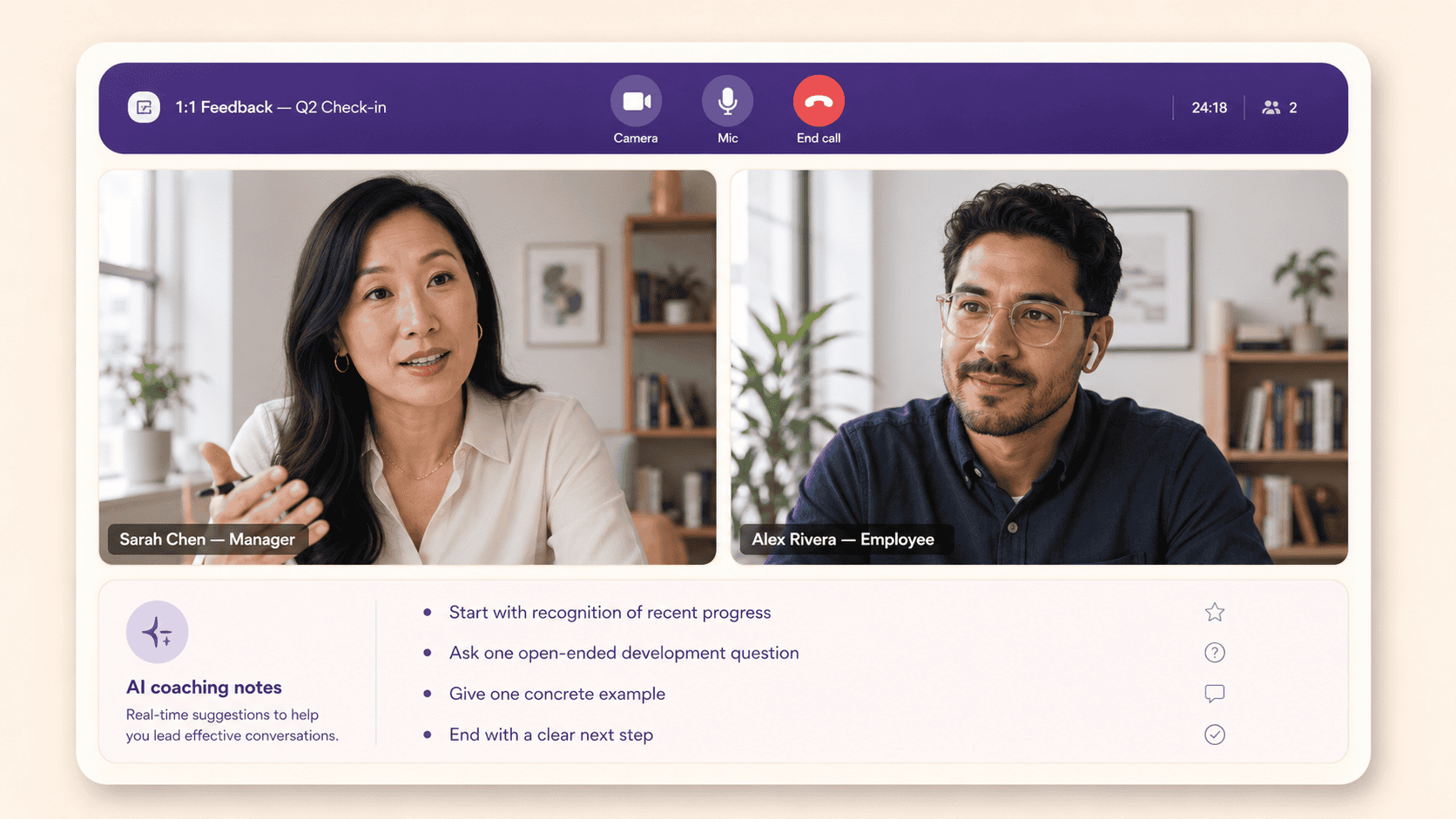
AI-powered role-play solves the scale problem without sacrificing quality. Learners interact with an AI avatar that responds dynamically, stays in character, and delivers instant, structured feedback on communication style, tone, and behavioral competency. Participants can repeat the same scenario multiple times, something impossible in human-led formats, which is critical for building the muscle memory that drives real behavior change.
The data increasingly favors AI-powered practice for volume and consistency. 43% of revenue enablement leaders now use AI-powered roleplay to enhance coaching, up from near zero three years ago. For enterprise L&D teams who need to train hundreds of managers consistently, the hybrid model, AI for daily practice, human coaches for nuanced debrief, is becoming the standard.
“One reason that organizations find it difficult to implement role-plays and high-fidelity simulations is that they require trained human role players. However, generative AI capabilities mean that these human role players could potentially be replaced with LLMs (Seitz et al., 2024), enabling organizations to scale up the use of high-fidelity simulations.”
(Boyce, Hickman & Boyce, Oxford Handbook of Personnel Assessment and Selection, 2026)
Coachello’s AI Avatar Roleplays are built on exactly this hybrid principle: AI-driven simulations for scale, integrated with certified human coaches for the depth of feedback that AI alone can’t yet replicate. The programs make this easier by letting participants practice asynchronously, at their own pace 24/7, so they arrive having already run the scenario at least once. This dramatically improves the quality of group debriefs.
Step 4: Prepare Your Participants (Not Just Your Facilitators)
Most role-play programs invest heavily in briefing facilitators and almost nothing in preparing the people who actually do the role-play. This is backwards.
Participants who arrive unprepared tend to perform poorly not because they lack the skills, but because they’re managing the anxiety of performing in front of colleagues. Poor performance in a role-play environment doesn’t always reflect real-world capability, it reflects the stress of the exercise itself.
Good preparation includes:
- Sharing the scenario context in advance. Participants should know the situation, their character, and the goal. Springing a scenario on someone cold tests their ability to improvise, not their ability to have a skillful conversation.
- Providing the competency framework. Let participants see the rubric they’ll be scored against. Transparency removes defensiveness and focuses energy on the right behaviors.
- Running a low-stakes warm-up. A short, simple scenario before the main exercise gets participants out of their heads and into practice mode.
Step 5: Run the Sessions and Build in Repetition
A single role-play session is better than none. But a single session will not change behavior.
Behavioral change requires repetition across spaced intervals. The science is clear: practicing a skill once, receiving feedback, and then not returning to it for three weeks produces negligible long-term improvement. Effective programs build in multiple touchpoints, an initial session, a self-practice period, a follow-up session two to three weeks later, and manager observation in the real workplace.
In practice, this means designing your program as a journey rather than an event:
- Week 1: Introduction to the scenario, first live practice, initial debrief
- Weeks 2–3: Independent practice (AI roleplay works particularly well here, available on-demand, no scheduling required)
- Week 4: Group debrief on common failure points observed in practice data
- Weeks 5–8: Manager observation and coaching in real-world application
This structure is what separates a role-play program from a role-play exercise. The former drives behavioral change. The latter gives L&D teams a box to tick.
Enterprise platforms like Coachello are built for this kind of journey-based delivery, tracking participant progress across multiple sessions, flagging where individuals are plateauing, and generating cohort-level insights that allow L&D leaders to intervene where it matters most.
Step 6: Run a Structured Debrief: This Is Where the Learning Consolidates
The role-play itself is the practice. The debrief is where the learning actually lands.
A weak debrief sounds like: “Good job, what did everyone think?” A strong debrief is structured, specific, and forward-looking:
What happened? Ask the participant to self-assess first, before any external feedback lands. Self-reflection activates the learning more deeply than being told what went wrong.
What worked? Identify specific moments — not vague praise. “The way you paused before responding to the objection in minute two showed real composure” is useful. “You did well” is not.
What would you do differently? Avoid framing this as “what went wrong.” The question is what the participant would change if they ran the scenario again — which keeps the feedback future-focused and actionable.
What is the one thing to practice before next time? End every debrief with a single, concrete commitment. Multiple takeaways get forgotten. One specific intention gets acted on.
With Coachello automate the first layer of debrief with instant competency scores and behavioral feedback after every session. This frees human facilitators to focus on the nuanced, contextual coaching that AI cannot yet fully replicate, making the overall debrief process both faster and deeper.
Step 7: Measure What Matters and Build the Business Case
L&D leaders who can’t demonstrate ROI lose budget. Role-play programs are uniquely well-positioned to generate measurable data, if you set up the measurement framework before you launch.
At the skill level: use competency scores from each role-play session to track improvement over time. Are participants scoring higher on the feedback delivery rubric in session three than they did in session one? If not, why not?
At the behavioral level: use manager observation data in the weeks after the program. Are managers seeing the trained behaviors show up in real conversations? The gap between role-play performance and real-world application is where many programs underdeliver, and where coaching follow-up is critical.
At the business level: tie outcomes to KPIs that leadership cares about. Coachello clients have reported measurable improvements including a 37% boost in leadership confidence at Enedis, 90% of Microsoft managers gaining increased clarity in their development path, and a +33% improvement in discovery conversation quality for sales teams. These are the numbers that secure next year’s L&D budget.
This is where having the right infrastructure matters. Coachello, for instance, gives L&D leaders real-time dashboards tracking participation, engagement, and skill progression at both individual and cohort level, so when a CHRO asks what the program delivered, the answer is in the data, not a post-survey anecdote.
Common Mistakes L&D Leaders Make When Building Role-Play Programs
Knowing the framework is one thing. Avoiding the traps that undermine even well-designed programs is another. The most common failure modes:
Skipping the measurement setup. If you don’t define what success looks like before you launch, you’ll have nothing to show for the program afterward. Build your metrics framework into the program design, not as an afterthought.
Running one session and calling it a program. A single role-play exercise is not a program. Without spaced repetition and reinforcement, skills regress. Design for a journey.
Using scenarios that are too generic. “Handle a difficult customer” is not a scenario, it’s a category. Specificity is what makes role-play feel real and relevant. The more closely the scenario mirrors an actual situation participants face, the more transfer you get.
Neglecting psychological safety. People do not learn well when they’re afraid of looking incompetent in front of peers. Create a low-stakes environment, especially for first sessions, by normalizing imperfect performance and framing role-play as practice, not assessment.
Under-investing in the debrief. The debrief is not the admin at the end of the session. It’s the most important part of the entire program. Budget time for it accordingly.
AI-first platforms like Coachello address several of these pitfalls structurally, by letting participants practice privately before any group session, delivering immediate objective feedback that removes the subjectivity of peer observation, and tracking progress across the full journey rather than a single event.
The Role of AI in Modern Role-Play Program Design
Building a role-play program in 2026 without considering AI is like designing a blended learning program without considering video in 2015. The technology has matured enough to be a serious component of enterprise L&D, not a novelty.
The core value AI brings to role-play programs is scale without quality loss. Human-led role-play is excellent but expensive and hard to standardize. AI role-play is available on-demand, scores consistently against a rubric, adapts dynamically to participant responses, and generates data that human-led programs cannot.
This does not mean AI replaces human facilitation. The most effective programs in 2026 combine both: AI avatars for high-volume practice and consistent scoring, human coaches for nuanced feedback, context-specific guidance, and the emotional intelligence that AI still cannot fully replicate.
Coachello’s AI Avatar Roleplay platform is built around this hybrid model, hyper-personalised AI simulations for day-to-day practice, integrated with ICF-certified human coaches for depth. Clients including Microsoft, Philip Morris International, and Engie have used this model to deliver skill development at enterprise scale, with measurable outcomes that map directly to business KPIs.
Building a Role-Play Program That Lasts
A role-play training program is not a one-time project. It’s an infrastructure decision. The organizations that get lasting returns from role-play are those that build it into the operating rhythm of their L&D function, as a standard component of onboarding, manager development, sales enablement, and leadership programs, rather than deploying it as a standalone initiative.
The seven-step framework above gives you the foundation: clear objectives, realistic scenarios, the right delivery format, prepared participants, spaced repetition, structured debriefs, and a measurement framework that connects to business outcomes.
What makes the difference between a program that changes behavior and one that produces a training completion metric is commitment to the full loop, practice, feedback, repetition, and real-world application.
If you’re building or rebuilding your approach to role-play training, Coachello works with L&D teams to design, deploy, and measure roleplay programs at scale, combining AI-powered practice with human coaching to drive the behavioral change that workshops alone cannot deliver.
Ready to see what a role-play program looks like in practice? Book a free consultation with the Coachello team and explore how AI avatar roleplays can be built into your existing L&D infrastructure.
Share this article


Unlock the Power of Coaching
Enhance leadership, boost performance, and drive growth with AI-powered and human-led coaching. Read articles from coaches, psychologists, and business leaders to help you boost performance, improve well-being, and lead with confidence.

Enter your email and we’ll send you the brochure