
AI Roleplay Scenarios for Difficult Workplace Conversations: A Practical Guide for Managers
August 11, 2026
10 minutes


Newly promoted managers step into the role with a striking gap built in: 85% receive no formal training, even though the job is, at its core, a string of hard conversations — feedback, conflict, underperformance, delegating work nobody wants to own (Gartner, cited via Fast Company). The pattern that follows is familiar across most organizations: the conversation gets softened into vagueness, avoided for another sprint, or handled so bluntly it backfires — and the same issue resurfaces weeks later, a little worse than before.
What actually closes that gap isn’t more theory. Managers who train with AI roleplay simulations improve targeted skills by 25.9% on average and reach full on-the-job effectiveness roughly 30% faster than those trained through conventional workshops alone (CareerTrainer.ai, 2026) — not because they absorb more content about feedback, but because they rehearse the actual back-and-forth enough times that it stops feeling like a threat once it happens for real.
This guide breaks down five of the highest-value scenarios to build into a manager roleplay program, a full example script with debrief questions, and the practical mechanics of running it well enough that it changes real behavior.
- 85% of new managers receive no formal training, despite the role being fundamentally a series of hard conversations.
- AI roleplay improves targeted skills by 25.9% on average and reaches full effectiveness 30% faster than conventional workshops.
- The scenarios worth rehearsing all share one trait: unpredictable human resistance — feedback, conflict, and delegation pushback.
- A working example script and debrief questions are included below, ready to adapt for your own program.
- The programs that actually change behavior combine AI repetition with periodic human debriefs — not one or the other.
Not every management skill benefits equally from roleplay. Scenarios worth rehearsing share one trait: they involve unpredictable human resistance, where a script or checklist breaks down the moment the other person doesn’t respond the way the training material assumed they would. Feedback conversations, conflict mediation, and delegation under pushback all fall into this category — which is exactly why they’re where managers report the most anxiety and the least preparation.
This connects directly to what Coachello calls the Practice Gap Model: managers usually understand what a good conversation should sound like in theory, and still fail to execute it under pressure, because they’ve never had a safe space to rehearse the actual back-and-forth before doing it live with a real direct report. AI roleplay closes that specific gap.
5 High-Value AI Roleplay Scenarios for Managers
| Scenario | Skills developed |
|---|---|
| 1. Feedback to a defensive report | Non-judgmental language, active listening under pushback, staying anchored to observable behavior |
| 2. Delegating under pushback | Negotiation under resistance, workload prioritization, delegation that builds trust |
| 3. Underperformance conversation | Structured difficult-conversation delivery, emotional regulation, clarity under pressure |
| 4. Mediating team conflict | Mediation, active facilitation, real-time de-escalation |
| 5. Delivering bad news | Direct communication under emotional weight, validating without capitulating, forward-focused recovery |
1. Delivering Critical Feedback to a Defensive Direct Report
Scenario setup: A high performer has started missing deadlines and their work quality has slipped. When the manager raises it, the employee becomes defensive, cites external pressures, and pushes back on whether it’s really a problem.
Learning objectives: Deliver specific, behavior-based feedback without triggering defensiveness; hold the line on the standard without escalating the conflict; end the conversation with a concrete next step both sides agree on.
Skills developed: Non-judgmental language, active listening under pushback, and staying anchored to observable behavior rather than character judgments.
2. Delegating Under Pushback: When a Report Resists a New Assignment
Scenario setup: A manager assigns a stretch project to a direct report who immediately pushes back, citing an already-full workload and past experiences of being “dumped on.”
Learning objectives: Distinguish between genuine capacity concerns and resistance to change; negotiate scope without simply withdrawing the request; frame the assignment in terms of the employee’s own development.
Skills developed: Negotiation under resistance, workload prioritization conversations, and delegation that builds trust instead of eroding it.
3. Managing Underperformance: The Performance Improvement Conversation
Scenario setup: An employee has been formally underperforming for two quarters. The manager needs to deliver a performance improvement plan while the employee grows increasingly emotional and questions whether the process is fair.
Learning objectives: Present clear, documented expectations without sounding punitive; hold space for the employee’s reaction without derailing the structure of the conversation; clarify what happens next and by when.
Skills developed: Structured difficult-conversation delivery, emotional regulation while holding a firm line, and clarity under pressure.
4. Navigating Conflict Between Two Team Members
Scenario setup: Two direct reports have an ongoing conflict that’s started affecting the wider team’s morale. The manager has to mediate a three-way conversation where both sides believe they’re right.
Learning objectives: Stay neutral without appearing to take sides; surface the actual underlying issue rather than the surface-level complaint; drive the conversation toward a working agreement rather than a resolution neither party actually accepts.
Skills developed: Mediation, active facilitation of a two-person conflict, and de-escalation in real time.
5. Delivering Bad News: Denied Promotions, Role Changes, or Layoffs
Scenario setup: A manager has to tell a direct report they didn’t get a promotion they expected and worked hard for, and the employee reacts with visible disappointment and starts questioning their future at the company.
Learning objectives: Deliver disappointing news directly without over-softening it into ambiguity; validate the employee’s disappointment without over-apologizing; redirect toward a concrete development path forward.
Skills developed: Direct communication under emotional weight, validating without capitulating, and forward-focused conversation recovery.
Example AI Roleplay Script: Defensive Employee, Missed Deadlines
Context: Jordan has missed three deadlines in six weeks on a project the team is depending on. The manager, Alex, is raising it in a 1:1 for the first time directly.
Alex: “Jordan, I wanted to talk about the last few deadlines on the client project. We’ve missed three in a row, and I want to understand what’s going on.”
Jordan: “Honestly, the scope keeps changing on me. I don’t think it’s fair to say I’m the one missing deadlines when the requirements aren’t even stable.”
Alex: “I hear that the scope changes have made this harder — that’s useful for me to know. At the same time, I need us to figure out how to hit dates even when scope shifts, because the team downstream is blocked each time. Can we walk through what happened on the last one specifically?”
Jordan: “It’s not like I wasn’t trying. I was juggling two other things you asked me to prioritize.”
Alex: “You’re right that I asked you to take those on too, and I should have been clearer about priority order — that’s on me. Going forward, when you’re juggling competing priorities, I want you to flag it to me before the deadline, not after. Can we agree on that as the change starting now?”
Jordan: “Yeah, I can do that.”
Alex: “Good. So for this week’s deliverable specifically — where are we, and what do you need from me to hit it?”
Debrief Questions for Coaches or Managers-in-Training
- Where did Alex acknowledge Jordan’s point without conceding the actual standard? What specific phrasing made that possible?
- At what moment did Jordan’s defensiveness start to lower, and what did Alex say immediately before that shift?
- Alex took partial ownership (“I should have been clearer”) without fully absorbing blame for the missed deadlines. How did that affect the rest of the conversation?
- How would this conversation need to change if Jordan had responded with silence instead of pushback?
How to Run Effective AI Roleplay for Manager Training
| Practice | Why it matters |
|---|---|
| Build scenarios from real situations | Pull anonymized patterns from actual manager escalations, exit interviews, or engagement survey themes so practice reflects what managers genuinely face. |
| Let the AI adapt, not follow a fixed script | A defensive employee who de-escalates should behave differently than one who digs in further — that branching teaches recovery, not just delivery. |
| Set a clear objective before each session | So the manager knows what “good” looks like going in, rather than treating the roleplay as an open-ended improv exercise. |
| Pair AI practice with a human debrief | AI excels at repetition and private practice; a human coach adds judgment on the highest-stakes conversations. |
| Track competency change over repeated attempts | A manager who runs the same scenario three times should show measurable improvement in tone, structure, or de-escalation — that’s the real signal a program is working. |
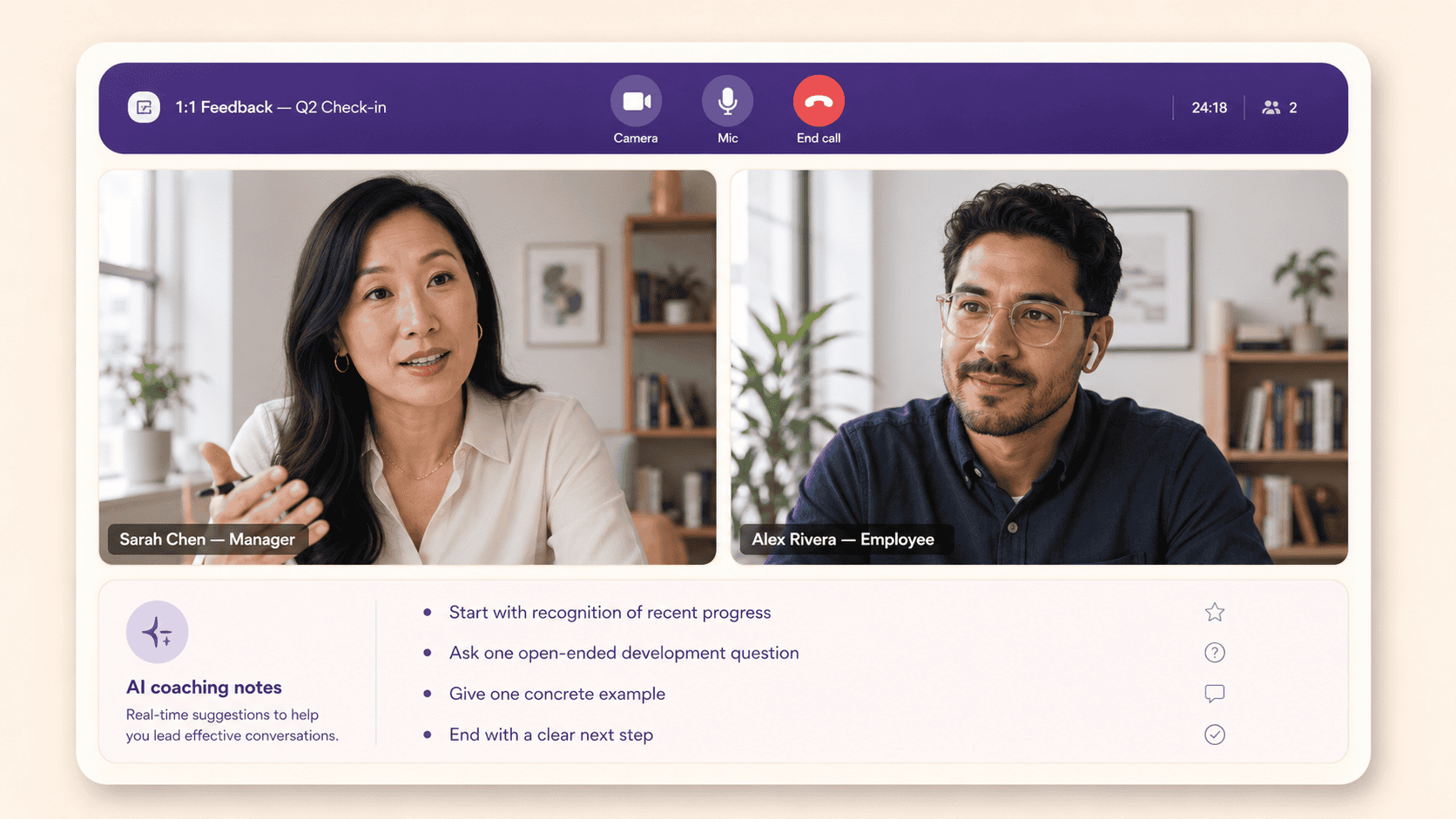
AI avatar roleplays layered onto human coaching are built around exactly this combination. For the specific methodology behind measuring whether skills are actually improving across attempts, see role-play for soft skills measurement.
Common Mistakes to Avoid
- Making every scenario the same “angry employee” archetype. Real workplace conflict shows up as silence, over-agreeableness, and passive resistance just as often as visible anger — a program that only trains for confrontation misses most of what managers actually encounter.
- Skipping the diagnostic step. Assigning generic scenarios to every manager, regardless of what they’re actually struggling with, wastes practice time on skills they may not need.
- No debrief structure. Roleplay without a structured set of reflection questions afterward turns into practice without learning — the debrief is where the behavior change actually gets locked in.
- Treating it as a one-time training event. A single roleplay session before a workshop ends doesn’t build a reflex. The scenarios that matter most — feedback, conflict, delegation — need to be revisited periodically as new situations come up.
- Launching without manager buy-in. Programs that get real adoption bring managers into the “why” before assigning the practice; see how to launch a corporate role-play program for the full rollout framework.
Practicing Conversations Before They Become Crises
The conversations covered here — feedback, delegation, underperformance, conflict, bad news — aren’t rare events. They’re the weekly reality of managing people, and they’re also exactly the conversations most managers were never trained to have, a gap explored further in why manager engagement is collapsing.
Practicing them in a safe, repeatable environment before they happen for real is the difference between a manager who freezes under pressure and one who’s rehearsed the moment enough times that it doesn’t rattle them. Platforms like Coachello build these scenarios into structured programs that combine AI avatar roleplays, AI coaching, and human coaching, so managers get both the repetition AI enables and the judgment a human coach brings to the highest-stakes conversations.
Which AI coaching solution fits your team?
Frequently Asked Questions: AI Roleplay Scenarios for Managers
What management scenarios benefit most from AI roleplay?
Scenarios worth rehearsing share one trait: unpredictable human resistance, where a script or checklist breaks down the moment the other person doesn’t respond as expected. Feedback conversations, conflict mediation, and delegation under pushback all fall into this category — exactly where managers report the most anxiety and the least preparation.
What are the 5 highest-value AI roleplay scenarios for managers?
Delivering critical feedback to a defensive direct report, delegating a task under pushback, managing a formal underperformance conversation, mediating conflict between two team members, and delivering bad news such as a denied promotion or layoff.
How much does AI roleplay actually improve manager skills?
Managers who train with AI roleplay simulations improve targeted skills by 25.9% on average and reach full on-the-job effectiveness roughly 30% faster than those trained through conventional workshops alone.
What makes an AI roleplay program actually change manager behavior?
Building scenarios from real manager escalations rather than generic templates, letting the AI adapt to the manager’s actual responses instead of following a fixed script, setting a clear objective before each session, pairing AI practice with periodic human debriefs, and tracking competency change across repeated attempts.
What are the most common mistakes in manager roleplay programs?
Making every scenario the same “angry employee” archetype and missing quieter forms of resistance, skipping a diagnostic step before assigning scenarios, running roleplay without a structured debrief, treating it as a one-time event, and launching without manager buy-in.
Ready to Build a Roleplay Program That Actually Changes Behavior?
Book a free consulting call to see which of these scenarios would have the biggest impact for your managers first.
Share this article


Unlock the Power of Coaching
Enhance leadership, boost performance, and drive growth with AI-powered and human-led coaching. Read articles from coaches, psychologists, and business leaders to help you boost performance, improve well-being, and lead with confidence.

Enter your email and we’ll send you the brochure