
AI Roleplay for Leadership Training: How Leaders Can Rehearse Difficult Conversations
November 26, 2026
6 minutes

Why Companies Need AI Roleplay for Leadership Training
AI roleplay for leadership training is gaining ground across HR and L&D teams for one simple reason: traditional manager training keeps failing at the exact moment it matters most. Only 27% of companies that train first-time managers deliver that training before the manager actually starts managing people, according to ATD research. Gartner’s own research adds the other half of the picture: the average manager now carries 51% more responsibilities than they can realistically manage, and only 25% of HR leaders feel confident their investments in manager development are actually working.
So why does so much leadership training fail to change behavior on the job?
Most managers have already sat through the workshop on feedback or conflict. What they haven’t done is test that knowledge against a real reaction. Platforms like Coachello, alongside a growing number of corporate training providers, are closing that gap with structured, realistic roleplay practice, this article covers why the gap exists, the framework behind closing it, and how to evaluate the investment.
The Conversational Muscle Model: Why Knowledge Alone Doesn’t Build Better Managers
There’s a simple way to explain why so much leadership training doesn’t survive contact with a real conversation. Call it the Conversational Muscle Model: workplace skill isn’t just knowledge, it’s Knowledge plus Practice plus Feedback. Remove either of the last two variables, and the behavior doesn’t stick, no matter how good the content is.
Most corporate leadership training delivers the first variable extremely well. Slide decks, workshops, and e-learning modules are efficient at transmitting a framework for giving feedback or handling conflict. What they almost never deliver is a safe place to actually try that framework against a reaction that pushes back — and without that, the muscle never actually forms.
The evidence for this isn’t new. ATD’s research on new-manager training found that even among the minority of companies that train first-time managers at all, only 37% rate that training as highly effective — a number that should be far higher if knowledge transfer alone were the answer. A 2017 meta-analysis in the Journal of Applied Psychology (Lacerenza et al.), synthesizing 335 studies and more than 26,500 participants on leadership training effectiveness, found that programs combining practice, demonstration, and information produced a combined effect size of 2.20, among the largest found anywhere in the organizational training literature, and dramatically larger than information-only formats. Practice isn’t a nice-to-have addition to leadership training. It’s the variable the research says actually matters.
The Real Cost of Leaving This Gap Unaddressed
The business case for closing this gap isn’t abstract. Gartner’s research puts a number on what an effective manager is actually worth: employees who report to effective managers are 15.4 times more likely to be high performers, and 3.2 times more likely to stay with their employer. Run that against current attrition and performance costs, and the gap between an adequate manager and a well-practiced one compounds fast. A separate, widely-cited Gallup finding puts a number on why that’s true in the first place: roughly 70% of the variance in team engagement comes down to the manager alone, not the role, the team, or the broader company culture.
When managers lack conversational confidence, the fallout rarely shows up on an L&D dashboard right away, it shows up as silent operational drag. Underperformers stay uncoached for months because a manager dreads the friction. High performers quietly disengage because they never get candid growth feedback. Cross-functional projects stall because nobody wants to challenge a peer’s missed deadline. Every avoided conversation becomes an invisible tax on team velocity.
Coaching investment specifically has one of the better-documented ROI profiles in corporate L&D. A global survey by PricewaterhouseCoopers and the Association Resource Center found an average return of seven times the cost of employing a coach — a figure the International Coaching Federation cites widely as the baseline business case for coaching spend. Separately, ICF and the Human Capital Institute’s 2023 research on coaching culture found 72% of respondents linking coaching directly to increased employee engagement.
None of this is controversial among HR leaders, the harder problem is operational, not philosophical. Gartner found that only 25% of HR leaders feel confident their current investments in manager development are actually working. That confidence gap is rarely a budget problem. It’s a design problem: most manager development still stops at the information stage, without ever building in the practice-and-feedback loop the Conversational Muscle Model depends on.
How AI Roleplay for Leadership Training Closes the Practice Gap
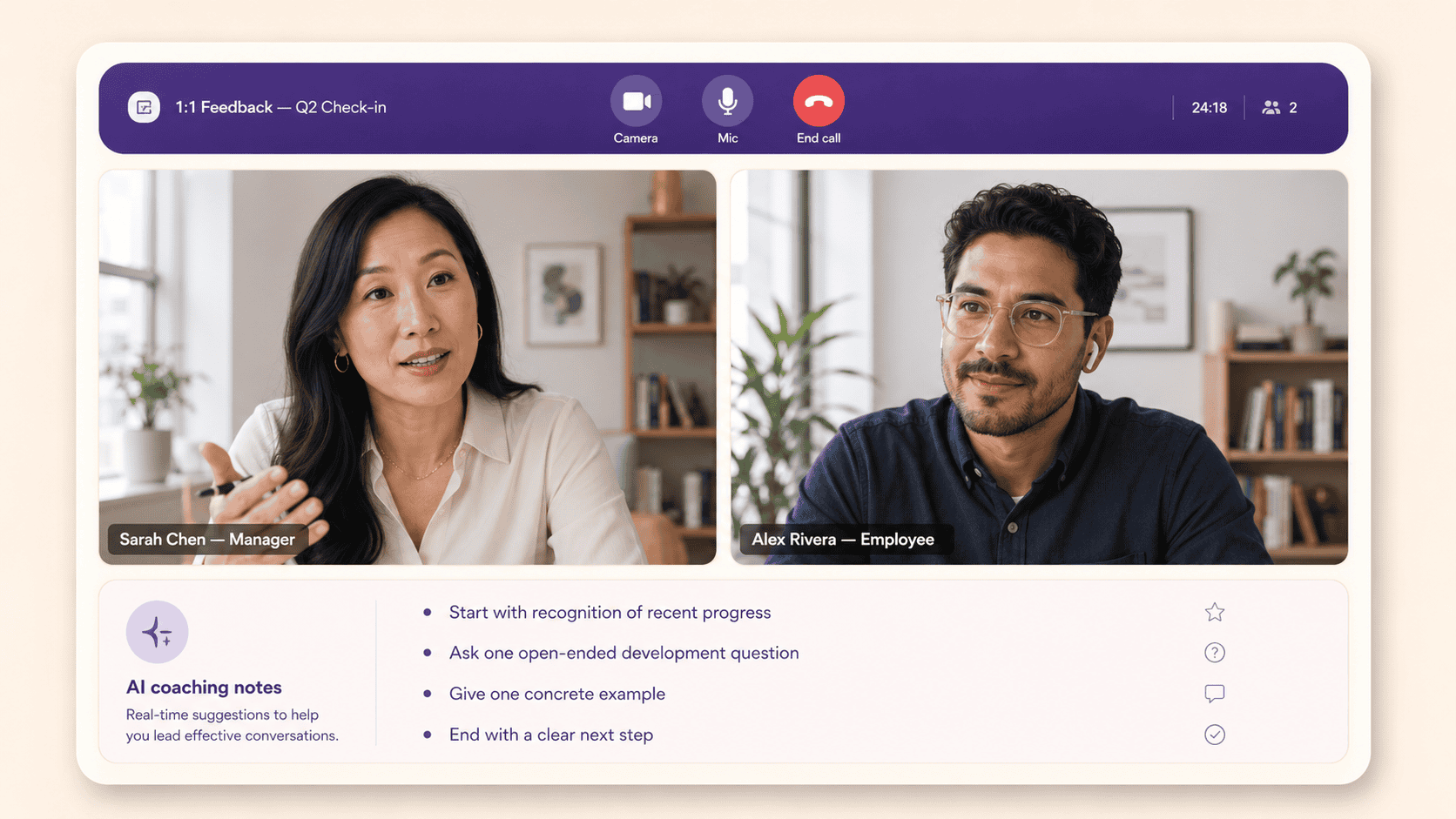
If the missing pieces are Practice and Feedback, the obvious bottleneck is scale. A human coach or workshop facilitator can only role-play one difficult conversation with one manager at a time, and that time is expensive. AI roleplay for leadership training solves the scale problem directly: a manager has a realistic, dynamic conversation with an AI-driven persona, a direct report receiving tough feedback, a peer pushing back in a meeting — and gets specific, actionable feedback on how they handled it, on their own schedule, as many times as needed.
This isn’t a theoretical mechanism. A 2025 meta-analysis in the International Journal of Instruction (Fu & Li), focused specifically on roleplay-based training, found the strongest effects on skill development in particular, with an effect size of 1.170, exactly the category of outcome that lecture-based leadership training consistently struggles to move. Platforms like Coachello build this capability directly into AI Avatar Roleplay: practice conversations embedded inside Microsoft Teams or Slack rather than behind a separate login, specifically so rehearsal happens where managers already work. The design logic matters as much as the technology. AI roleplay isn’t meant to replace a manager’s human coach or their real conversations — it’s meant to be the rehearsal space in between, where a manager can get the rough version of a hard conversation out of the way privately, so the version their team actually sees is the practiced one.
Proof From the Field: AI Avatar Roleplay at Philip Morris International
The clearest evidence for this approach comes from organizations that have already rolled it out at scale. At Philip Morris International, leadership shared the following assessment of AI Avatar Roleplay as part of its manager development program:
“The AI Avatars gave our managers something we couldn’t scale with traditional training: a safe, realistic space to try, fail, and try again with real feedback conversations.”
The program reported a 15% improvement in feedback skills, 79% voluntary engagement from participating managers, a 4.6-out-of-5 satisfaction score, and 10 times faster skill progression compared with the organization’s prior training approach.
How to Introduce AI Roleplay Without Disrupting Existing Leadership Programs
Companies that get real adoption out of AI roleplay for leadership training tend to approach the rollout the same way, regardless of size or industry:
- Start with two or three scenarios: A small set of high-stakes, high-frequency conversations — delivering feedback, delegating, managing up builds confidence in the tool faster than a sprawling scenario library nobody has time to explore.
- Keep it paired with human coaching or existing leadership programs, not positioned as a replacement for either: The rehearsal happens with AI; the real relationship and judgment-based development stays with a human coach or manager.
- Embed it inside the tools managers already use daily: A platform that requires a separate login competes with everything else on a manager’s to-do list, and tends to lose that fight.
- Measure past completion rates: Whether managers “finished” a roleplay module matters far less than whether their actual feedback frequency, delegation rate, or team engagement scores shift afterward.
For organizations comparing this approach against other options, a side-by-side look at the leading AI coaching platforms is a useful starting point, as is a deeper look at why HR leaders are making this switch in the first place. For teams still mapping how AI coaching fits into a broader leadership development strategy, this overview of AI coaching platforms built for leadership covers the adjacent ground this article doesn’t.
Closing the Gap, One Conversation at a Time
The data is consistent across every source cited here: companies keep investing in leadership training, and HR leaders keep doubting whether it’s working. The reason usually isn’t the content, it’s that most programs stop at Knowledge and never build the Practice and Feedback legs the Conversational Muscle Model depends on.
AI roleplay for leadership training is one of the more scalable ways to close that specific gap, without replacing the human coaching relationship that still matters most. Organizations like Philip Morris International and Enedis have already shown what that looks like in measurable terms, faster skill progression, higher engagement, and real gains in manager confidence.
See how Coachello’s AI Avatar Roleplay fits inside an existing leadership development program — book a demo.
Share this article


Unlock the Power of Coaching
Enhance leadership, boost performance, and drive growth with AI-powered and human-led coaching. Read articles from coaches, psychologists, and business leaders to help you boost performance, improve well-being, and lead with confidence.

Enter your email and we’ll send you the brochure