
Role-Play for Soft Skills: How to Measure What Traditional Training Programs Miss
June 24, 2026
11 minutes

The global soft skills training market is projected to reach $97.4 billion by 2034, growing at 11.29% annually. Organizations are spending more than ever on communication, leadership, and interpersonal skills development. Yet 91% of L&D professionals admit soft skills are increasingly important to business performance, while only 36% actually track their impact beyond a post-training satisfaction survey.
This is the central paradox of soft skills development in large organizations: the investment is growing, the urgency is real, and the measurement infrastructure is almost entirely absent. The problem isn’t motivation, it’s method. Traditional training programs, workshops, e-learning modules, lecture-based courses, generate completion data and learner reaction scores. They do not generate behavioral evidence. And behavioral evidence is the only kind that proves a soft skill has actually developed.
Role-play is the most robust tool available to L&D leaders for both developing and measuring soft skills. This article examines the research behind that claim, explains exactly what role-play measures that traditional programs miss, and provides a practical framework L&D leaders can use to turn practice sessions into proof.
The Soft Skills Crisis in Large Organizations
The scale of the soft skills gap in enterprise organizations is consistently underestimated. The data tells a striking story.
51% of workers (including 58% of managers), say there is a notable lack of interpersonal skills in their industry (Educate360, 2025). Among a global assessment of more than 70,000 manager candidates, 61% struggled to clarify core issues in high-stakes conversations, a foundational communication failure that cascades into poor team performance, avoidance of feedback, and unresolved conflict (ACU, 2023).
The organizational cost is not abstract. 70% of mid-career professionals cite frustration with their manager’s communication and emotional intelligence, not pay, not job duties, as their primary reason for leaving (TechClass, 2025). Managers who actively develop soft skills boost employee engagement by up to 70%, yet only 27% of managers are currently rated as highly skilled in conflict resolution.
Meanwhile, the market for leadership development is dominated by programs that prioritize knowledge delivery over behavioral practice. A senior manager can complete a course on giving feedback, pass a knowledge test, and return to their team no more capable of having a difficult conversation than when they started. The gap between training completion and behavioral competence is where organizations lose the return on their L&D investment, and it is precisely where role-play is designed to intervene.
Why Traditional Training Programs Can’t Measure Soft Skills
The most common metrics used in corporate soft skills programs are:
- Completion rates: did people finish the training?
- Satisfaction scores (NPS or CSAT): did people enjoy it?
- Knowledge assessments: can people answer questions about the content?
These are Level 1 and Level 2 metrics in the Kirkpatrick Model, the most widely used framework for evaluating training effectiveness. The problem is stark: 73% of organizations stop measuring training effectiveness at Level 1 or Level 2, according to Training Industry, never reaching Level 3 (behavioral change) or Level 4 (business results), which are the only levels at which real ROI becomes visible.
Soft skills are invisible at Levels 1 and 2. You cannot measure whether someone communicates with greater clarity, manages conflict more constructively, or gives more effective feedback by asking them how the training felt or what they remember about it. Those metrics measure the training experience, not the human capability that training was meant to develop.
The fundamental structural problem with most soft skills programs is this: they treat understanding as a proxy for competence. A manager who understands the principles of effective feedback is not the same as a manager who can deliver it, under pressure, to a resistant employee, in real time. The gap between knowing and doing is where soft skills development most commonly breaks down, and it’s a gap that no satisfaction survey or multiple-choice assessment can detect.
Only 20% of employees successfully apply new skills from training without active, ongoing reinforcement, meaning that for the other 80%, even well-designed programs don’t produce durable behavioral change without a practice infrastructure to support them (TechClass, 2025).
The Kirkpatrick Problem: Where Soft Skills Measurement Breaks Down
The Kirkpatrick Model, developed in the 1950s and still the dominant framework in L&D evaluation, assesses training across four levels:
| Kirkpatrick Level | What It Measures | Common Method | Soft Skills Visibility |
|---|---|---|---|
| Level 1: Reaction | Did learners enjoy it? | Satisfaction surveys, NPS | ❌ None |
| Level 2: Learning | Did learners gain knowledge? | Tests, quizzes, assessments | ⚠️ Limited (measures recall, not application) |
| Level 3: Behavior | Did behavior change on the job? | Manager observation, 360° reviews | ✅ High (but rarely measured) |
| Level 4: Results | Did business outcomes improve? | KPIs, retention, performance data | ✅ Very high (but almost never connected to training) |
The vast majority of corporate soft skills programs live and die at Levels 1 and 2. Level 3 (behavioral change) is described by Kirkpatrick researchers as “the make-or-break level,” because without sustained behavior change, higher-level impact is impossible regardless of satisfaction scores.
Role-play is the only training method that generates Level 3 evidence during the training process itself — not weeks later, not through manager observation, but in real time, as the learner performs the skill under simulated conditions. That’s the measurement breakthrough it represents.
What Role-Play Actually Measures
When role-play is properly designed and scored, it generates a category of evidence that no other training format can produce: observed behavioral performance in a simulated high-stakes environment.
Specifically, a well-structured role-play session can measure:
Communication quality: clarity of message, use of open vs closed questions, pace and structure of conversation, ability to adapt tone to a resistant counterpart.
Emotional regulation: how the learner responds when the scenario escalates, whether composure is maintained under simulated pressure, ability to de-escalate tension without deflecting.
Structured thinking: adherence to frameworks (STAR, SBI, SPIN, GROW), logical sequencing of a difficult message, ability to move a conversation toward a concrete outcome.
Listening and responsiveness: whether the learner responds to what the counterpart actually says, or defaults to a scripted response regardless of what’s happening in the conversation.
Behavioral consistency across repetitions: arguably the most important metric. Does performance improve from session one to session three? Does the learner under pressure in run two behave differently than they did in run one?
These are not abstract qualities. They are observable, scorable, and (with the right platform) trackable over time at both individual and cohort level.
The Key Metrics Role-Play Training Generates
The following measurement framework outlines the specific data points that a structured role-play program, particularly AI-powered, can generate consistently across a large learner population.
| Metric | What It Captures | Why It Matters |
|---|---|---|
| Competency Score per Session | Behavioral performance against a predefined rubric (e.g., feedback quality, discovery depth) | Replaces subjective manager impression with objective, comparable data |
| Score Progression Over Time | How performance scores change across multiple sessions with the same scenario | The clearest evidence of skill development — more reliable than any single assessment |
| Session Frequency & Voluntary Engagement | How often participants initiate practice without being required to | Proxy for intrinsic motivation; at PMI, 79% of participants joined voluntarily, 3x the corporate learning norm |
| Open-to-Closed Question Ratio | In sales/discovery scenarios: balance of exploratory vs. confirmatory questions | Directly linked to deal quality and client conversation depth |
| Scenario Completion Rate | Whether participants complete or abandon a scenario | Signals psychological safety and engagement with difficulty |
| Framework Adherence Score | Whether the learner follows the intended model (SPIN, SBI, GROW, etc.) | Connects practice to the organization’s chosen methodology |
| Emotional Tone & Composure Indicators | In AI-powered sessions: language patterns associated with defensiveness, avoidance, or clarity | Surfaces behavioral tendencies invisible in a written assessment |
| Cohort-Level Performance Distribution | Aggregated data showing where a team or organization sits on a skill curve | Helps L&D leaders identify systemic gaps vs. individual development needs |
| Pre/Post Behavioral Shift | Comparison of competency scores before and after a program | The closest proxy to a controlled study that enterprise L&D can realistically produce |
| Manager Observation Correlation | Whether AI-generated scores align with manager-observed behavior in the real workplace | The bridge between the practice environment and real-world performance |
The Benefits of Role-Play for Soft Skills Development and Measurement
The table below summarises the evidence-backed benefits of AI Roleplays as both a development and a measurement tool, compared to the most common alternatives.
| Benefit | Role-Play | E-Learning Module | Workshop / Lecture | 360° Review |
|---|---|---|---|---|
| Generates behavioral evidence | ✅ Yes (in real time) | ❌ No | ⚠️ Limited | ⚠️ Lagging indicator |
| Scalable across large org | ✅ With AI | ✅ Yes | ❌ Limited by facilitator capacity | ✅ Yes |
| Measures skill under pressure | ✅ Yes | ❌ No | ❌ No | ⚠️ Subjective |
| Supports spaced repetition | ✅ Yes | ⚠️ Rarely | ❌ No | ❌ No |
| Provides immediate feedback | ✅ Yes (AI-powered) | ⚠️ Automated only | ❌ Delayed | ❌ Periodic |
| Produces comparable data over time | ✅ Yes | ❌ No | ❌ No | ⚠️ Limited |
| Connects to business KPIs | ✅ With framework | ❌ Rarely | ❌ Rarely | ⚠️ With effort |
| Supports psychological safety | ✅ Private practice | ✅ Yes | ⚠️ Group exposure | ⚠️ Depends on culture |
| Enables L3/L4 Kirkpatrick evidence | ✅ Yes | ❌ No | ⚠️ With manager observation | ✅ Yes |
From Practice to Proof: What the Data Says
The research base supporting role-play as the most effective vehicle for soft skills development is substantial, and growing.
A McKinsey study found that companies investing properly in soft skills training experience a 22% increase in productivity, with every dollar spent returning $4.53 in value. When soft skills programs are properly designed with practice at their core, ROI can reach 256%, but the vast majority of programs are not properly designed, which is why the average outcome is far lower (ATD, 2024).
The retention argument is equally strong. Research consistently shows that active practice produces significantly higher knowledge and skill retention than passive learning methods, and that skills learned through repetitive, contextual practice transfer more reliably to real-world performance than those acquired through observation alone (Udemy Business, 2025).
In organizational settings, the outcomes from Role-play programs are becoming increasingly documented:
- Philip Morris International managers improved feedback-giving skills 10x faster than through traditional workshops, with 79% joining sessions voluntarily, three times the corporate learning norm.
- ENGIE ran a targeted coaching pilot with 69 participants and achieved 94% positive session impact within three weeks, with self-assessed performance rising from 4.75 to 7.19 out of 10.
- Microsoft managers using Coachello’s coaching programs showed a consistent average score of 4.2/5 and 40% improved self-proclaimed progress across leadership competencies.
- In feedback-specific programs, managers have reported +12% improvement in feedback-giving quality — a metric directly observable by their teams.
These aren’t satisfaction scores. They are behavioral performance metrics, collected during and after practice, correlated to real-world improvement. That is the measurement standard traditional soft skills programs almost never reach.
How AI Has Changed the Measurement Game
For most of the history of role-play in L&D, the measurement bottleneck was human. A trained facilitator could run a role-play and offer qualitative feedback. But that feedback was subjective, inconsistent across facilitators, and impossible to scale, meaning that measurement at cohort level was not practically achievable.
AI-powered roleplay platforms have removed that bottleneck.
The most advanced platforms now deliver:
Automated competency scoring against pre-defined rubrics, eliminating facilitator subjectivity and enabling consistent measurement across hundreds of participants simultaneously.
Behavioral pattern analysis: AI can detect linguistic and conversational patterns (hedging language, question ratios, response latency, composure indicators) that human observers often miss in real-time observation.
Longitudinal tracking: AI sessions are recorded and scored consistently, L&D teams can build a true skill development curve for each individual and each cohort, rather than relying on point-in-time assessments.
Predictive insights: some platforms can identify which behavioral patterns in early role-play sessions correlate with later performance outcomes, enabling earlier and more targeted intervention.
“AI can accurately, efficiently, and reliably evaluate high-fidelity behavioral responses.” Hickman et al. (2023) showed the same for assessment center role-plays. This is critical, given that human assessor training and rating time has traditionally been a major barrier to widespread adoption of simulations with high-fidelity (e.g., open-ended) responses. High response fidelity can improve both validity and fairness.”
(Boyce, Hickman & Boyce, Oxford Handbook of Personnel Assessment and Selection, 2026)
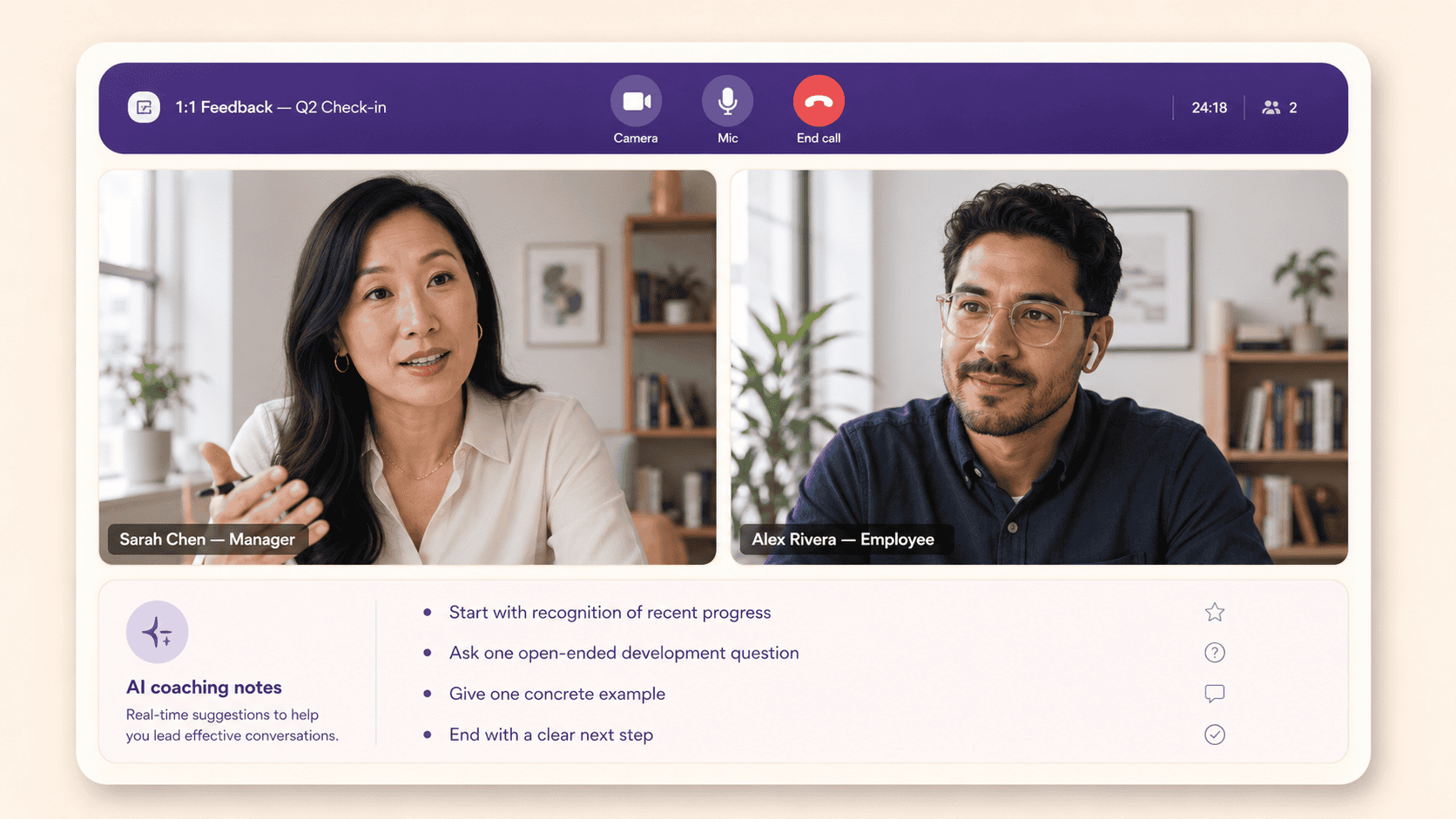
Coachello’s AI Avatar Roleplay platform generates all of these metrics as a native output of every session: competency scores, behavioral feedback, individual progression curves, and cohort-level analytics visible to L&D leaders in a real-time dashboard. For HR and L&D teams that need to demonstrate the impact of their soft skills programs to leadership, this is a fundamentally different evidence base than the completion reports and satisfaction surveys that have historically defined the field.
A Measurement Framework for L&D Leaders
If you’re building or auditing a soft skills program, the following framework maps the measurement approach to each stage of a role-play program:
Before the program: establish baselines: Run an initial diagnostic role-play session scored against your competency rubric. This creates the baseline against which all future improvement is measured. Without a baseline, you cannot demonstrate ROI.
During the program,track practice data: Monitor session frequency, scenario completion rates, and competency score trends across the cohort. Identify which participants are plateauing and intervene early. Aggregate data to surface systemic skill gaps vs. individual development needs.
After the program, measure behavioral transfer: Combine AI-generated performance data with manager observation ratings and, where available, downstream business KPIs (close rates, retention data, 360° feedback changes). This is the Level 3 and Level 4 evidence that makes the business case for continued investment.
Ongoing, embed practice as infrastructure: The most durable soft skills development doesn’t come from a program with a start and end date. It comes from building practice into the regular rhythm of work — monthly role-play sprints, scenario updates that reflect new organizational challenges, and manager coaching conversations grounded in real behavioral data.
Coachello’s coaching platform is designed around exactly this principle, giving L&D leaders the infrastructure to make role-play a continuous, data-generating component of their people development strategy, rather than a one-time event.
Why This Is the Next Big Thing in L&D
The convergence of three trends is making role-play with behavioral measurement the defining L&D methodology of the next decade:
The skills economy is accelerating. The World Economic Forum estimates that 44% of workers’ core skills will need to change by 2027, with interpersonal and leadership skills among the most in-demand. Organizations that can develop these skills faster than their competitors, and prove they’ve done so will have a durable talent advantage.
AI has removed the scale barrier. The practical constraint that kept role-play as a small-group, facilitator-dependent methodology has been solved. AI roleplay platforms can now deliver consistent, scored practice to thousands of employees simultaneously, at a fraction of the cost of equivalent human-led sessions.
L&D is under more pressure to prove ROI than ever. In an era of tightened budgets and executive scrutiny, L&D leaders who can produce behavioral evidence, not just completion certificates — will win the resources to keep developing their programs. Role-play with AI-powered measurement is the clearest path to that evidence.
Organizations that invest in building behavioral measurement infrastructure now, rather than waiting for it to become industry standard — will be three to five years ahead of the curve in their ability to demonstrate, and therefore accelerate, human capability development at scale.
The Measurement Gap Is Also an Opportunity
Traditional soft skills training has a measurement problem that has protected mediocre programs for decades: if you can’t measure whether something works, you can’t prove it doesn’t. Role-play with behavioral measurement removes that protection, but it also creates something far more valuable. It creates proof.
Proof that feedback skills improved by 12% in eight weeks. Proof that new managers handled a difficult performance conversation more effectively after three practice sessions. Proof that a sales team’s discovery conversation quality rose by 33% following a targeted roleplay program. These are the numbers that earn L&D a seat at the leadership table, and they are only available through practice-based, behaviorally-scored methodologies. Coachello exists at exactly this intersection,combining AI Avatar Roleplays, ICF-certified human coaching, and real-time analytics into a platform purpose-built for organizations that want to develop soft skills at scale and measure the results with the same rigour they apply to any other business investment.
If your current soft skills program can’t answer the question “how do we know it worked?”, that’s the gap worth solving first.
Share this article


Unlock the Power of Coaching
Enhance leadership, boost performance, and drive growth with AI-powered and human-led coaching. Read articles from coaches, psychologists, and business leaders to help you boost performance, improve well-being, and lead with confidence.

Enter your email and we’ll send you the brochure