
10 Ways to Use Role Play in Professional Development (With Real Workplace Examples)
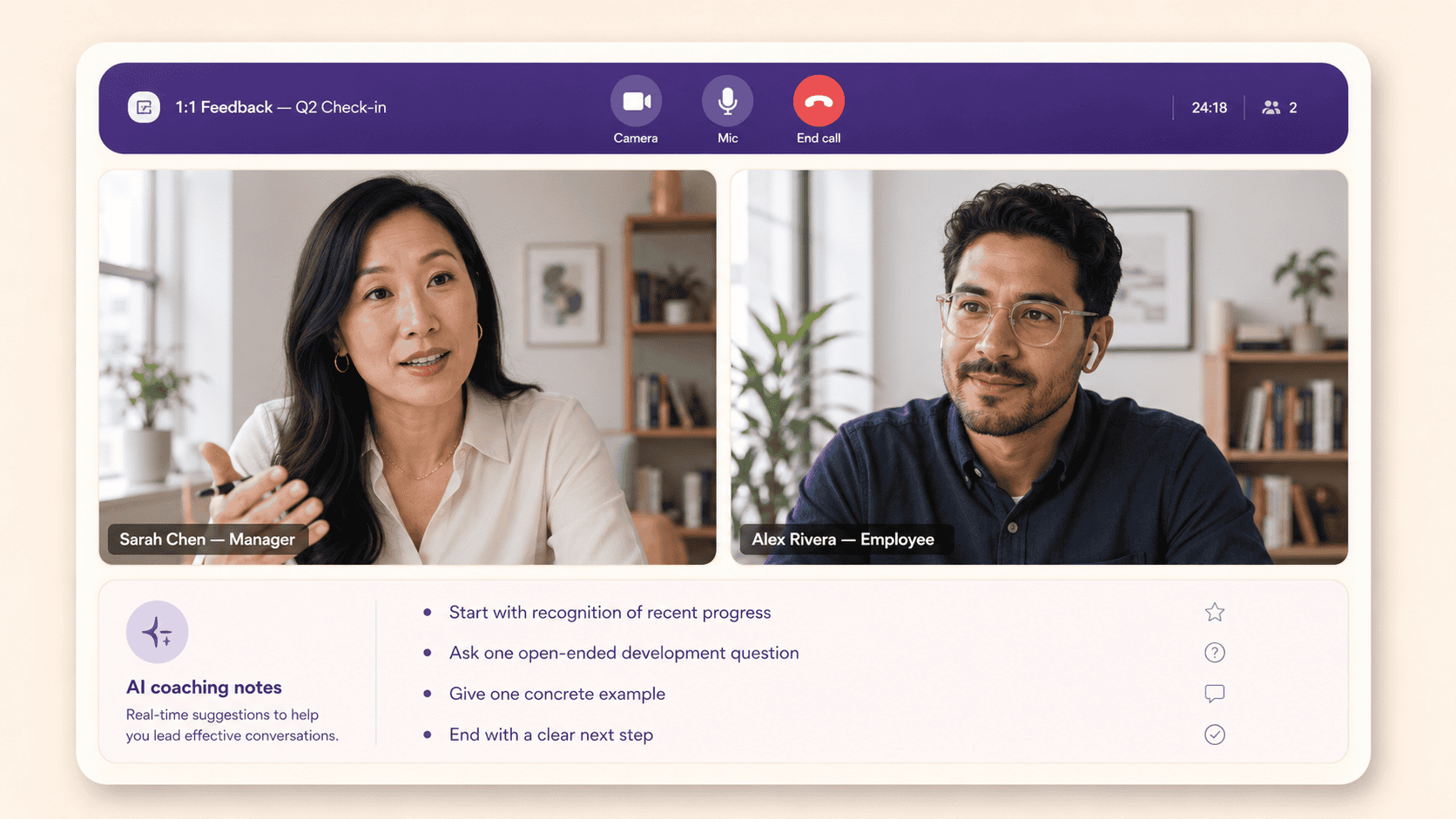
June 24, 2026
11 minutes
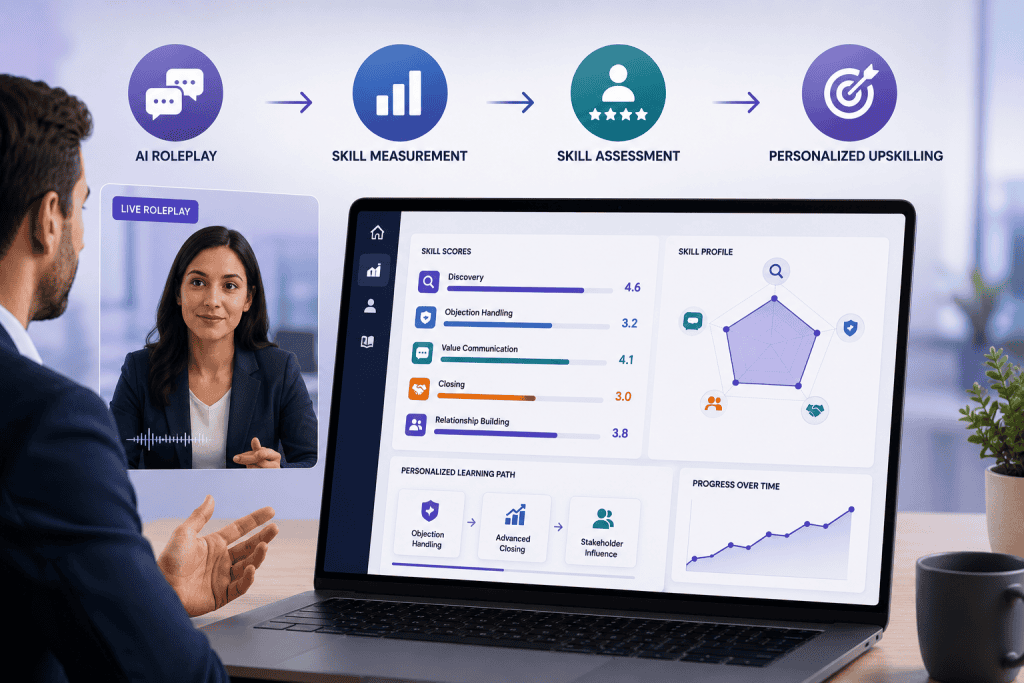
5% of employees experience workplace conflict, yet 60% of managers have never received formal training in how to handle it. Meanwhile, new sales hires need over 100 realistic practice conversations to build confidence, but traditional coaching gives them 5 to 10. The skills gap in today’s workplace isn’t a knowledge problem. It’s a practice problem.
Role-play is the most direct solution available to L&D teams. It turns passive learning into active performance, moving people from understanding a concept to being able to execute it under real pressure. Organizations that build role-play into their professional development programs report up to 30% improvement in soft skills effectiveness and a 40% reduction in the time it takes to develop those skills.
This article covers 10 specific, high-impact ways to use role-play in professional development, each with a concrete workplace example and the data to back it up. Whether you’re an HR leader building a new program or a manager looking to sharpen your team, these applications will give you a practical starting point.
Ask any Chief Human Resources Officer (CHRO) or Learning & Development (L&D) Director about their biggest headache right now, and they won’t tell you it’s a lack of content. They have thousands of hours of content.
The real problem? Your employees know what to do. They just freeze when it’s time to actually do it.
Organizations globally spend over $370 billion annually on corporate training. Yet, research on the “Forgetting Curve” shows that human beings forget up to 75% of new information within just six days if they don’t immediately apply it. Employees attend flashy workshops, check the box on compliance modules, and watch webinars. But the moment a high-stakes client pushes back or a direct report gets defensive, they revert right back to their old, comfortable habits.
To bridge this gap, forward-thinking organizations are abandoning passive learning and doubling down on a classic tool reinvented for the modern era: Interactive Role Plays.
By simulating high-stakes workplace friction in a zero-risk environment, role play transforms abstract theory into behavioral reality. Thanks to modern AI coaching platforms, this practice is no longer a logistical nightmare—it is scalable, highly personalized, and data-backed.
Here are 10 highly critical workplace scenarios where role play is moving the needle on organizational performance, backed by real-world data.
1. Manager Feedback Conversations
Giving effective feedback is one of the most frequently cited skill gaps in leadership development. Studies show that managers who give high-quality, regular feedback are linked to teams with 14.9% lower turnover — yet most managers avoid difficult feedback conversations entirely, or give feedback so vague it produces no behavioral change.
Role-play is the most effective way to close this gap because it forces practice in the actual moment of discomfort: sitting across from someone, delivering a hard message, and holding the conversation through resistance.
Real workplace example: A mid-level manager at a manufacturing company is about to address a team member who consistently misses deadlines. In a role-play session, a colleague plays the defensive employee, pushing back with “I’ve been doing this for 10 years — why is this suddenly an issue?” The manager must stay composed, stay specific, and steer toward a committed outcome. By the third run-through, the manager has found their language and their confidence.
Coachello’s Feedback that Lands program is built around exactly this scenario — AI avatars that respond with realistic resistance, pushing managers to develop feedback skills through repetition, not just reflection. Clients using this program have reported a +12% improvement in feedback-giving quality within weeks of starting.
2. Sales Discovery and Objection Handling
Reps using AI roleplay simulations are 3.7 times more likely to hit quota compared to those trained through traditional methods. That single statistic makes the case for role-play as a core component of any sales enablement program.
The most valuable sales conversations to practice are discovery calls and objection handling — the moments where deals are won or lost, and where inexperienced reps most commonly freeze or default to scripted responses that don’t land.
Real workplace example: A B2B SaaS company is onboarding a cohort of 15 new account executives. Rather than shadowing senior reps for three weeks and hoping something sticks, each new hire runs 20+ AI-powered discovery call simulations before their first live call. The AI persona pushes back with common objections — “We already have a solution,” “Can you send me something to review?” — and scores each rep on question quality, listening cues, and next-step clarity.
Coachello’s Sales Mastery program enables exactly this kind of high-volume, scored practice at scale — with one senior sales executive reporting a +33% improvement in discovery conversation quality after completing the program.
3. Onboarding New Hires Faster
The average time for a new employee to reach full productivity is 8 to 12 months. AI-assisted roleplay onboarding cuts this significantly — with documented cases of organizations reducing ramp time by 42 to 60% through structured scenario practice.
The logic is straightforward: new hires need to build contextual confidence, not just product knowledge. Role-play puts them inside the situations they’ll face — difficult customers, internal escalations, first one-on-ones with their team — before those situations happen for real.
For store teams, an AI roleplay platform for retail sales training lets new associates practise customer greetings, product discovery and objections before their first shifts.
Real workplace example: A financial services firm onboards 30 new client-facing associates each quarter. The first two weeks of their onboarding now include daily 15-minute AI roleplay sessions covering client objections, compliance-sensitive conversations, and internal escalation scenarios. By week three, new associates are handling live calls with a level of composure that previously took months to develop.
This is one of the core use cases on Coachello’s platform, where the Onboarding to Autonomy program adapts scenarios to each hire’s role and level — helping organizations accelerate ramp-up while reducing the attrition that often follows a slow, unsupported start.
Want to cut your onboarding ramp time? See how Coachello’s onboarding program works →
4. Difficult Performance Conversations
Performance management is the area where most managers feel least prepared — and most likely to avoid the conversation until it’s too late. Research from SHRM finds that nearly half of emerging leaders struggle to manage underperformance directly, often defaulting to vague feedback or extended informal warnings that create legal and cultural risk.
The core challenge isn’t that managers don’t know what needs to be said. It’s that they haven’t practiced saying it. Role-play creates the muscle memory for holding a hard conversation without becoming either aggressive or so hedged that the message is lost.
Real workplace example: An operations manager needs to place a long-tenured employee on a performance improvement plan. The stakes are high — the employee has allies in the team and a history of taking feedback personally. In a role-play session, the manager practices the conversation three times: once where the employee gets emotional, once where they become defensive, and once where they accept the feedback but make unrealistic commitments. Each version requires a different response, and by the third run, the manager is no longer dreading the conversation.
Coachello has a dedicated Difficult Conversations program built for exactly these high-stakes moments — with AI avatars that adapt dynamically to the manager’s responses, creating realistic scenarios that prepare leaders for whatever direction a conversation takes.
5. Conflict Resolution Between Team Members
Workplace conflict costs U.S. employers an estimated $359 billion per year in lost productivity. The average employee spends 2.8 hours per week managing conflict — nearly four full work weeks per year. And yet, 72% of organizations have no formal policy or training in place to address it.
Role-play is one of the few training methods that can prepare people for the emotional complexity of conflict — not just the logical steps of resolution, but the experience of staying regulated when a colleague is not.
Real workplace example: Two team leads in a tech company are in escalating conflict over resource allocation. Their shared manager runs a facilitated role-play session in which each person takes the other’s role for 10 minutes. The exercise doesn’t resolve the dispute immediately — but it shifts the frame from “they’re being unreasonable” to “I understand why they see it that way,” which is where negotiation becomes possible.
If this kind of structured practice is something your L&D team wants to scale — beyond individual manager judgment — Coachello’s coaching platform supports both AI-driven conflict scenario practice and group workshop formats, giving HR leaders a reproducible approach rather than a one-off intervention.
6. Cross-Cultural Communication
Global teams are the norm, not the exception — and communication breakdowns across cultures remain one of the most underestimated sources of project failure, client attrition, and team friction. A misread tone, a misunderstood directness level, or an unrecognised hierarchy cue can derail a relationship that took months to build.
Role-play in cross-cultural training doesn’t aim to make people cultural experts. It aims to make them more observant, more curious, and more adaptive in the moment — which is a learnable, practicable skill.
Real workplace example: A European consulting firm assigns teams to a new client in Japan. Before the first engagement, team members participate in role-play scenarios simulating initial client meetings, status updates, and escalation conversations — each with realistic cultural tension built in. The facilitator (or AI persona) responds in ways that reflect Japanese business communication norms: extended silence, indirect disagreement, relationship-first agendas. Teams learn to read and adapt, rather than defaulting to their own cultural style.
Coachello’s Cross-Cultural Collaboration program was built for this exact use case — helping globally distributed teams practice the cultural nuance that no e-learning module can truly teach.
7. Negotiation Skills
Negotiation is one of the most financially consequential skills in any organization, and one of the most undertrained. Whether it’s a procurement manager negotiating supplier contracts, a sales leader closing enterprise deals, or an HR director negotiating an offer with a senior candidate, the difference between a skilled and unskilled negotiator shows up directly in business outcomes.
The challenge is that negotiation skills deteriorate fast without practice — and most professionals only negotiate high-stakes situations a handful of times per year, which isn’t enough to build fluency.
Real workplace example: A procurement team at a retail company introduces quarterly role-play sprints ahead of supplier renewal season. Each team member runs three to five negotiation scenarios against an AI counterpart briefed to hold firm on price, make concessions only on non-financial terms, and introduce time pressure late in the conversation. After two quarterly cycles, the team’s average contract savings per negotiation increased measurably — and the confidence to walk away from a bad deal, once rare, became standard.
Sales teams using AI-driven training tools have reported 20 to 30% improvements in negotiation efficiency and a reduction in discounting. The kind of repeated, scored practice that drives this improvement is exactly what Coachello’s platform enables — across sales, procurement, and leadership contexts alike.
8. Leadership Presence and Executive Communication
Leadership presence is notoriously hard to teach in a classroom. It’s the ability to project clarity, calm, and authority — to communicate in a way that earns trust and moves people. It is also, despite how innate it seems in skilled leaders, a learnable set of behaviors that role-play can develop.
The specific skills that role-play builds in this area include: managing pace and silence in high-stakes conversations, delivering messages with clarity under pressure, handling pushback without becoming defensive, and adapting communication style to different seniority levels.
Real workplace example: A VP of Engineering at a scale-up is preparing for board-level presentations and cross-functional leadership meetings with significantly more seniority exposure than she’s had before. Over six weeks, she completes a role-play coaching program: weekly scenarios simulating board Q&A, peer escalation conversations, and all-hands communication during a company restructure. By week four, her coach notes a measurable shift in her communication — less hedging, cleaner structure, stronger presence under pressure.
Senior leaders at companies including Microsoft have worked with Coachello to develop exactly these skills — with 90% of Microsoft managers reporting increased clarity in their development path after their Coachello program, and a consistent coaching score of 4.2 out of 5 across cohorts.
Building a leadership program for senior managers? Talk to the Coachello team about what’s possible →
9. Change Management Communication
Organizational change — restructures, new systems, leadership transitions, return-to-office mandates — is one of the most predictable sources of employee disengagement and attrition. And yet, most change management programs invest in communications strategy and almost nothing in preparing managers to have the human conversations that change requires.
When employees are anxious about what a change means for them, they don’t need a polished cascade message. They need a manager who can sit with them, answer hard questions honestly, and communicate genuine empathy without either catastrophising or dismissing their concerns.
Real workplace example: A financial services company announces a significant technology-driven restructure affecting 400 roles. Rather than running a single briefing session for people managers, the L&D team deploys a role-play program two weeks before the announcement goes live. Managers practice four scenarios: the anxious high performer, the resistant team member, the employee who has already heard rumours, and the person who breaks down in the conversation. Each run-through is scored on empathy, clarity, and forward direction. By the time the announcement lands, managers are prepared — not just informed.
Coachello’s group workshop and AI coaching formats are well-suited to this kind of high-urgency, high-stakes preparation — designed to be deployed quickly and at scale when organisations need their leaders ready fast.
10. Customer Service and Client Escalation
Customer-facing teams are the most visible point of failure when skills break down under pressure. An escalated client, an unreasonable complaint, a billing dispute that threatens a long-term relationship — these are the moments that determine whether a customer stays or leaves. And they are moments that can be practiced.
Role-play in customer service training has one of the clearest ROI stories in L&D: organizations that implement structured roleplay for customer-facing teams report up to 30% higher customer retention rates and significant reductions in escalation rates.
Real workplace example: A SaaS company’s customer success team is losing clients at the renewal stage due to unresolved concerns raised in the final quarter of the contract. The CS leader introduces a monthly role-play program where team members practice renewal conversations against resistant, cost-conscious, and time-pressured client personas. Within two quarters, renewal conversation quality improves measurably — and the team reports significantly more confidence going into high-stakes client calls.
This is one of the highest-impact use cases for AI roleplay at scale. Rather than relying on senior managers to role-play with every team member individually, solutions like Coachello allow CS teams to run unlimited practice sessions — with consistent, objective scoring — freeing managers to focus on the nuanced coaching conversations that actually require human judgment.
The Common Thread: Practice, Not Just Knowledge
What these 10 use cases share is not a content type or a training format. They share a fundamental principle: the skills that matter most at work are learned by doing, not by being told.
Role-play closes the gap between knowing and doing. It creates a safe environment where failure is productive, repetition is encouraged, and feedback is immediate. And when it’s combined with modern AI tools that can scale the practice loop — delivering realistic scenarios on-demand, scoring performance consistently, and tracking progress over time — it becomes one of the most powerful investments an L&D team can make.
The organizations getting the most from role-play aren’t the ones running the most elaborate programs. They’re the ones that have built practice into the daily rhythm of their teams — in the flow of work, available on demand, tied to real performance outcomes.
How to Get Started
If you’re looking to introduce or scale role-play across any of the use cases above, the first step is choosing the right mix of human and AI-powered delivery for your context.
Coachello is a digital coaching platform combining AI Avatar Roleplays with ICF-certified human coaches — designed for HR and L&D leaders who need to develop leadership, sales, and communication skills at scale, with measurable outcomes that connect to business performance.
With programs covering feedback, difficult conversations, sales mastery, onboarding, cross-cultural collaboration, and leadership presence — and a track record with clients including Microsoft, Engie, Philip Morris International, and Enedis — Coachello gives L&D teams the infrastructure to make role-play a repeatable, data-driven part of their development strategy.
Share this article


Unlock the Power of Coaching
Enhance leadership, boost performance, and drive growth with AI-powered and human-led coaching. Read articles from coaches, psychologists, and business leaders to help you boost performance, improve well-being, and lead with confidence.

Enter your email and we’ll send you the brochure