
The 40:1 Manager: What’s Their Job Now?
April 22, 2026
9 minutes

I’ve been hearing something from inside big tech lately that really gave me a pause.
Some companies are experimenting with spans of control that could go as high as 40 to 1. That’s forty direct reports per single manager. The idea is to reset what an employee should actually expect from their manager — and one thing that quietly goes out the window in this model is your manager knowing you. Like, literally knowing you.
Onboarding? Done by a different department. Most of your training? Self-paced video and exercises. Maybe some cross-functional connection if you’re lucky. Rather than a bi-weekly or monthly 30-minute one-on-one with your manager, this model philosophizes: you don’t really need a one-on-one. You can get everything you need through well-orchestrated self-service portals, peers, mentors, and coaches. Kind of like “welcome, and you are on your own.”
Which leaves me, and I think it should leave every CHRO, CPO, and line-of-business leader — with one question: In this experiment, what does the manager actually do? Why are they there?
The squeeze is already here
A few months ago, the Wall Street Journal ran a piece by Chip Cutter and Lindsay Ellis titled, “Your Boss Doesn’t Have Time to Talk to You.” If you’re in HR or leading a business line, you probably read it and nodded grimly. If you haven’t, here’s the headline version.
In 2017, the average U.S. manager oversaw about five employees. By 2023, that ratio had tripled to roughly one manager for every fifteen. That’s about the same ratio I had at Google leading a globally distributed hybrid team in 2022. And what were some of the results? I think you may know. Google eliminated around 35% of their managers. Amazon told investors they want the ratio higher still. Intel cut 50% of their management layers. Estée Lauder, Match Group, Citibank — all cutting 20 to 50% of their managers. And 40:1 is no longer theoretical; it’s being piloted.
The managers who survived are managing teams that are two, three, even four times the size they once had. One manager quoted in the WSJ piece now oversees 36 direct reports and told his team: “Ask each other first — I can’t be the go-to person for every need.” Another described waking at 4:30 a.m. in what he called “a consistent state of inadequacy.”
And the data behind those voices has only sharpened. A 2026 Simon Sinek Optimism Company survey of 971 middle managers found that 75% report extreme burnout and disconnection, with more than one in four actively planning to leave their roles. Seventy-one percent of employees who survived a layoff report declining motivation, and culture and work-life balance ratings keep sliding — not just in the first month, but five months later. Gartner research shows disengagement and incivility can drive productivity dips of up to 25% and increase turnover likelihood by up to 50%.
This is not a staffing issue. It’s a human connection issue — and it’s showing up on the P&L.
The reframe: controller to coach
Here’s where it gets interesting. Deloitte’s 2026 Global Human Capital Trends report — surveying more than 9,000 leaders across 89 countries — tells us something important about where the manager role is heading. Because agentic AI is absorbing the administrative and routine work where managers historically spent roughly 40% of their time, managers are being asked to redirect that reclaimed bandwidth toward adaptability, psychological safety, and coaching. We have to ask ourselves: are managers in role today, those coming up the ranks, or those being hired externally — ready for this?
Get this: Deloitte goes further. The report envisions a shift from traditional management to what it calls “hybrid team leadership”: where the leader’s role moves from controller to strategist, coach, and specialist in solving creative and ethically complex problems. Success in this model, Deloitte argues, will depend 80% on leadership development, not IT.
Read that list again. Creative and ethically complex problems. That’s not a throwaway phrase. It’s a forecast. The problems coming at us, AI-driven decisions that affect livelihoods, hybrid workforces where fairness is harder to see, customer trust in a world of synthetic everything, team members navigating burnout while being asked to move faster — these are not optimization problems with clean answers. They are human judgment problems. And the manager of 2026 is being asked to hold the pen on more of them, more often, with less time than any manager before them. That’s the job. Without leaders equipped to think through this kind of complexity with both creativity and ethics, the AI tooling doesn’t save you. It accelerates your failure modes.
Read it again. 80% leadership development. Not the AI tooling. Not the workflow platform. The human capability of the leader.
The research converges from multiple vantage points. The i4cp 2026 CHRO Board captures it plainly: “In 2026, effective leadership is less about managing hierarchy and more about enabling networks. As work becomes more distributed, leaders are expected to orchestrate collaboration, trust, and connection across boundaries.”
So now the picture sharpens. The manager of 2026 doesn’t manage performance spreadsheets, systems, and status reports the way they used to, those are increasingly handled by AI agents and self-service portals. Instead, the manager becomes an orchestrator of both systems and humans. The conductor, not the drummer.
The gap nobody’s funding fast enough
Here is the part that keeps me up at night, and that I think should be keeping HR and L&D leaders up too:
If the new manager role is to orchestrate humans and AI agents, who is training the humans to orchestrate the humans?
This isn’t a philosophical question. It’s an operational question with a measurable cost.
The research converges. SHRM’s 2026 CHRO Priorities and Perspectives Report finds 46% of CHROs ranking leadership and manager development as their top 2026 priority — the second consecutive year it has held the #1 spot. Gartner’s 2026 survey of more than 400 CHROs reaches the same conclusion. Yet 75% of organizations that significantly updated their leadership programs are still not seeing the results they expected. Gartner also reports that improving job manageability has five times more impact than focusing on individual manager skills in isolation.
Deloitte layers on an even tougher number: 85% of leaders say it’s critical to build adaptability in their workforce, but only 7% say they’re actually leading that continuous growth. That gap — between knowing and doing — is where top talent quietly disengages and walks. And when that quiet disengagement takes hold, it spreads to others and multiplies, leading to loss of near-term productivity and talent. Not good.
And for line-of-business leaders in sales, operations, finance, marketing, and R&D — the internal customers of HR and L&D — this is not someone else’s problem. Your best revenue producer is not leaving because of comp. They’re leaving because nobody sees them in quite the same ways they used to be seen, or now want to be seen. They aren’t being drawn to competitors, start-ups, or a new industry just for money. No, there is another currency at play here: it’s called opportunity for connection and impact.
The Human-to-Digital Ratio℠ is the new manager competency
Years ago, I built a framework called Don’t Just Text, Connect!℠ The premise was simple then, and it’s more true now: in a workplace increasingly mediated by screens, authentic human connection isn’t a nice-to-have — it’s the competency that determines whether teams hold together or quietly fragment, often while they appear to be holding together.
Inside that framework sits an idea I call the Human-to-Digital Ratio℠. The question it asks is deceptively simple: in any given week, what is the ratio of real human interaction — eye contact, voice, presence, listening — to digital-only interaction (text, Slack, email, async video, AI chat) that you’re giving and receiving? For most managers today, that ratio has quietly tipped so far toward digital that their teams no longer feel known.
In the 40:1 world, managing that ratio intentionally is no longer a soft skill. It is the job. Because when AI handles the reports, the scheduling, the summarization, and the first-draft communications, the highest-value element a human manager uniquely contributes is human connection — the kind that builds trust, surfaces creative friction, and keeps top people engaged.
That competency can be learned. But it cannot be learned from a video module alone.
What scalable, embedded human connection actually looks like
This is where the coaching conversation has to get more sophisticated than it has been. For years, “coaching” in the enterprise meant a few executives got a human coach for an hour every other week and everyone else got an e-learning platform. That model doesn’t scale to thousands of stretched middle managers and those up and coming, and it doesn’t fit inside the flow of a manager’s actual day.
The model that does fit has three characteristics: it’s embedded where managers already work, it blends AI and human modalities intelligently, and it produces measurable behavior change rather than just completion certificates.
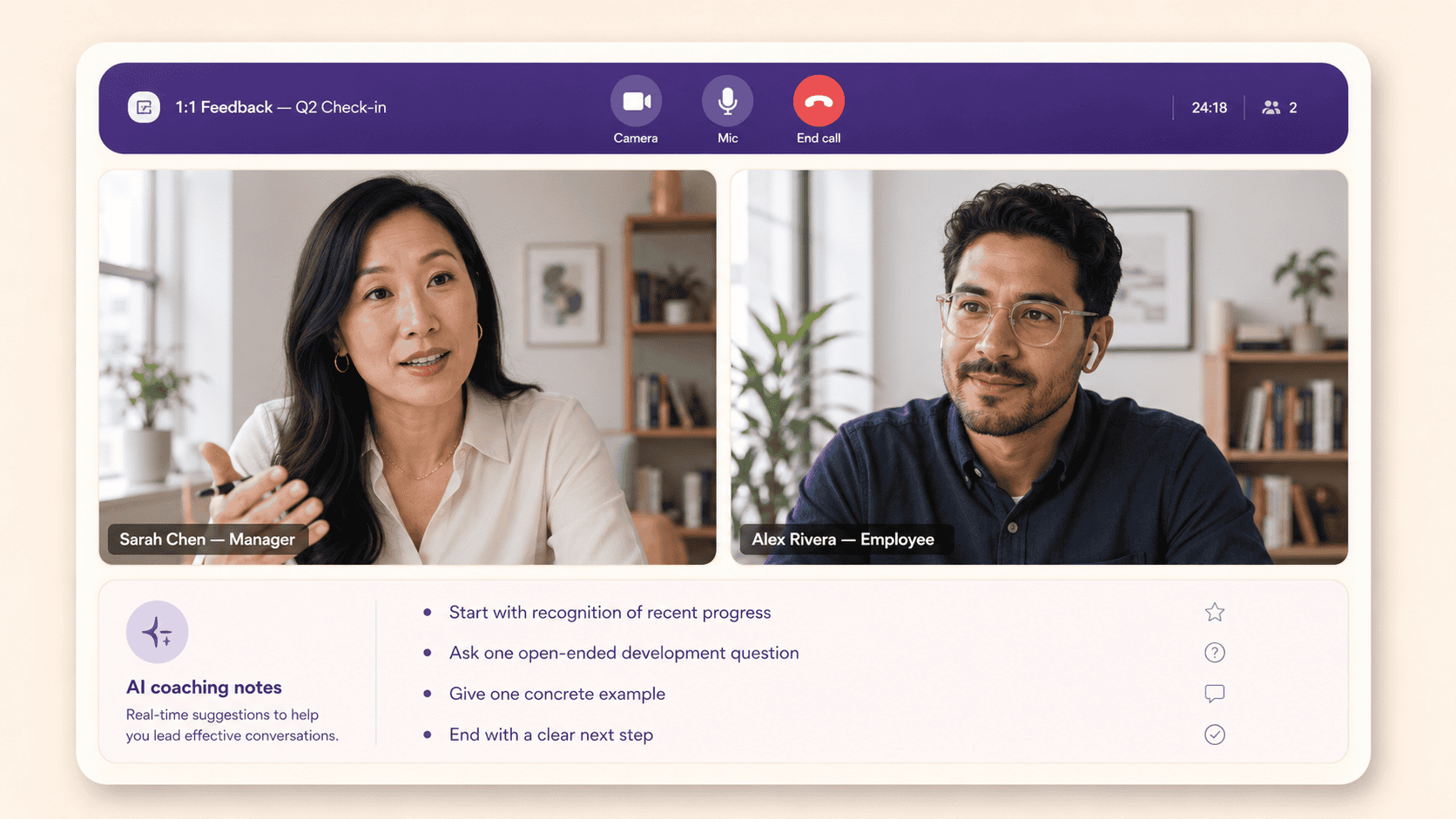
Coachello — one of the platforms I work with as a contract executive coach — is one example of what this looks like at scale, and I’ve watched it work. Coaching meetings take place inside whatever video meeting tool the client uses (Zoom, Teams, Google Meet), so there’s no separate coaching portal to remember and no additional login. The point isn’t the video tool; it’s that coaching shows up where managers already are, not in a separate learning platform they have to remember to log into. AI avatar roleplays give managers a safe, 24/7 environment to rehearse the high-stakes conversations they’re avoiding — giving feedback to an underperformer, navigating a difficult 1:1, delegating with clarity. And when those rehearsals surface the deeper developmental work, there’s a global bench of ICF-credentialed human coaches ready to go deeper.
The proof points are worth paying attention to, because they speak directly to the productivity and retention numbers HR leaders are accountable for.
- At Philip Morris International, managers using AI Roleplays to practice feedback conversations progressed roughly 10 times faster than they did with traditional training, with 79% voluntary engagement — nearly triple typical corporate learning participation.
- At Microsoft, a Copilot-team leadership program delivered a 3x reduction in reported stress, a 69% increase in motivation, and 97% of participants implementing concrete actions from their coaching.
- At Gorgias, facing hypergrowth-driven burnout across a 300+ person globally distributed team, the program produced an 8x reduction in stress, a 60% increase in motivation, and 98% of participants implementing actions — with 50% adoption company-wide in year one.
- At Meilleurs Agents, a 40-manager leadership coaching program during rapid scale-up produced a 3x reduction in stress, a 70% increase in motivation, and 97% of participants taking action.
Notice the pattern. These aren’t participation-rate numbers or course-completion scores. They are stress, motivation, and action — the exact leading indicators of the productivity protection and top-talent retention that a CFO will ask a CHRO to defend next quarter.
The measurable lever hiding in plain sight
Go back to the 40:1 manager. The question wasn’t whether that ratio is possible — in operational terms, with AI agents doing the administrative heavy lifting, it almost certainly is. The question was: what does the manager actually do?
Here’s the answer I’d offer to any CHRO, CPO, or line-of-business leader reading this: in the hybrid-leadership model Deloitte is describing, the manager’s job is to be the irreducibly human part of the system. The orchestrator of humans and AI. The person who notices when a top performer has gone quiet on three consecutive Slack threads. The person who can hold a difficult feedback conversation with warmth and clarity. The person who makes sure the Human-to-Digital Ratio℠ on their team never tips so far toward digital that their people stop feeling known.
And that manager — that orchestrator — is not self-training. They need a coaching infrastructure that meets them where they work, rehearses the hard conversations before they happen, and provides human depth when the stakes warrant it.
In an AI-saturated, distraction-heavy workplace, predictable human connection — delivered by managers who have actually been trained for this new role — is now the most measurable lever HR leaders have for protecting productivity and keeping the top talent their line-of-business partners cannot afford to lose.
The leaders of tomorrow are already inside your organization. Some of them are managing 15 people. A few of them are being asked to manage 40. The question isn’t whether they’re capable of the new role. The question is whether we’ll build the connection infrastructure — human and AI, together — that lets them show up for it.

Gary Danoff, is an executive coach, facilitator, and podcast host working at the intersection of human leadership and AI — a space he describes simply as Improving Human Connection in an AI World℠. Drawing on a career that spans leadership roles at Google and Microsoft, Gary coaches mid-to-senior leaders who want to lead with more clarity, trust, and presence — especially in organizations navigating the pressures and possibilities that AI brings.
He hosts What’s Next Now!, a podcast featuring leaders and contributors sharing their career journeys, serves as an executive coach and contributor at Coachello.ai and as a global facilitator and podcast host for LHH. Gary is a Professional Certified Coach (PCC) through the International Coaching Federation.
Share this article


Unlock the Power of Coaching
Enhance leadership, boost performance, and drive growth with AI-powered and human-led coaching. Read articles from coaches, psychologists, and business leaders to help you boost performance, improve well-being, and lead with confidence.

Enter your email and we’ll send you the brochure